When is a firefighter switch mandatory for a PV system?
Legal requirements, standards and practical examples for planners, installers and system operators – when is a PV firefighter switch required?
The safety of photovoltaic systems (PV systems) is a key issue, especially in the event of a fire. Technical standards and regulations play a decisive role here. DIN VDE 0105-100 governs the general requirements for operating electrical installations, while the application rule VDE-AR-E 2100-712 defines specific requirements for shutting down PV systems for emergency services. In addition, IEC 60947-3 specifies the requirements for switching devices and disconnectors that ensure safe shutdown. These standards form the technical basis for deciding when a firefighter switch is mandatory.
At a time of increasing use of renewable energy, photovoltaic systems are an important part of the energy transition. However, alongside their enormous potential for CO2 reduction, safety aspects are also in focus. PV system planners are repeatedly confronted with the question of whether it is necessary to use a firefighter switch. But what is the legal situation here? When is a firefighter switch mandatory? Which standard requires such a switch, and what arguments can be used to justify the additional costs to the customer?
Technical basis
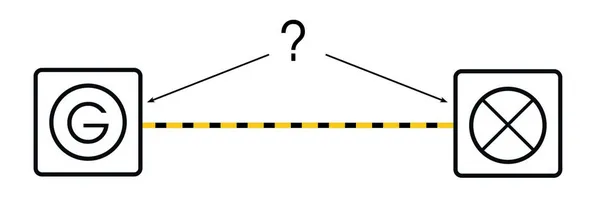
In electrical installations, the ability to isolate devices and cable runs is an essential part of the safety requirements. To illustrate this in a simplified way, let us look at the following diagram.
Shown are a generator and a connected load. Where would a professional ideally install the isolation point here?
If the isolating device were placed near the load, operating the switch would de-energize only the short section between the switch and the load—but the long cable run between the generator and the switch would remain energized. This entails risks, especially during maintenance work or in an emergency.
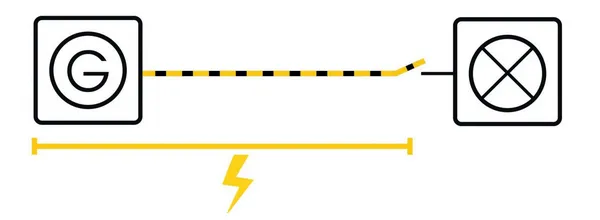
The optimal position for the isolator is therefore as close to the generator as possible. This ensures that as much of the cable between the generator and the load as possible can be de-energized.
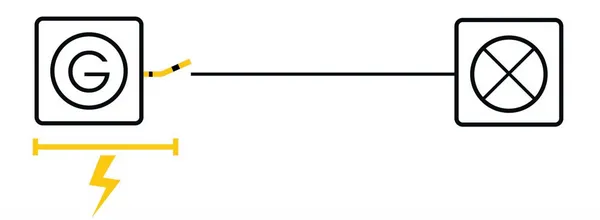
This fundamental safety requirement is described in DIN VDE 0105-100. The standard defines the five safety rules for work on electrical installations, including the requirement to isolate live parts before work begins. The principle that the cable route between the generator and the load is included in this disconnection is therefore not optional, but an essential safety requirement.
Technical background: how does a PV firefighter switch work?
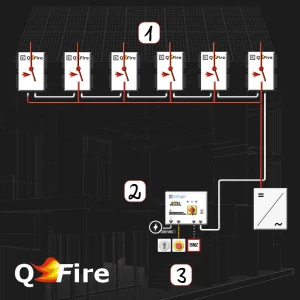
The question of whether a firefighter switch is required can only be assessed properly if the technical function is also understood. The key point is not only that a PV system is switched off, but where the disconnection takes place and whether the DC cables between the PV generator and the inverter are actually isolated.
On our technical page about QFire PV firefighter switches, we explain the design, function, DC disconnection, galvanic isolation and typical applications of firefighter switches for PV systems.
The particular challenge with PV systems
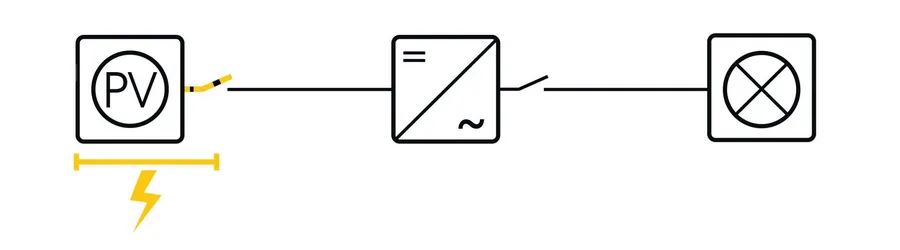
If we now consider this for a PV system, the generator corresponds to the photovoltaic system (PV modules). This means that the entire cable between the PV modules and the load—typically the inverter or the electrical distribution—must be de-energized in order to meet the safety requirements in accordance with DIN VDE 0105-100.
DIN VDE 0100-712
There are dedicated standards for PV systems that govern isolation, particularly on the direct current (DC) side. A key role is played by DIN VDE 0100-712, which defines requirements for the electrical safety and installation of PV systems. It requires that an isolation option be provided on the DC side of the PV system, in particular for maintenance work or hazard prevention.
A particular challenge is the DC voltage itself. Unlike AC, direct current has no zero crossing and, when simply switched off, will very quickly generate an arc, which poses particular hazards. This can lead to fire; the switch can “weld” and fail to interrupt the current flow; components can burn out. Switching DC in PV systems is therefore governed by IEC 60947-3.
Most inverters have an integrated DC isolator that complies with IEC 60947-3. However, if the inverter is not installed directly next to the modules, it is in the wrong place. If, for example, the inverter is installed in the basement and the cables run through the entire building, these cables—some carrying voltages of up to 1,500 volts—cannot be isolated in the event of a fire or even for maintenance! This poses a danger to life and limb in such situations and must definitely be avoided!

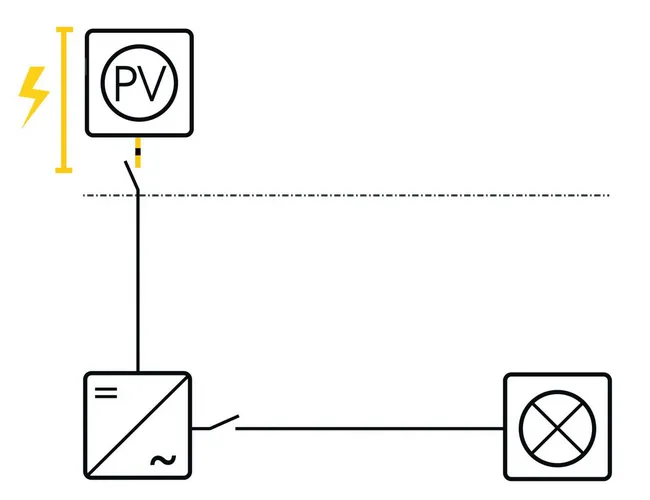
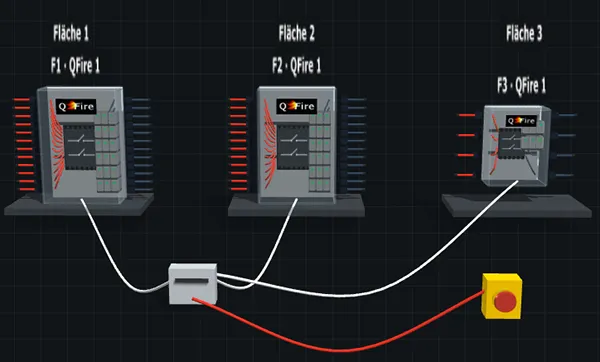
In order to be able to isolate the cable between the PV modules and the inverter as well, the isolator must be placed close to the generator, as described in the example above.
What does VDE-AR-E 2100-712 say?
The application rule clearly describes how the risk of electric shock, e.g. in the event of a fire, can be minimized—or better, eliminated—by using firefighter switches. Based on the standards described above and a clear technical understanding of the application and the potential hazards, it shows that PV systems must provide a means of protection close to the modules. Switching is carried out by galvanic isolation or short-circuiting in order to comply with this application rule. It should be noted that shutdown itself must be possible either via an external, accessible switch and, in an emergency, also by disconnecting the mains voltage. It should also be noted that, in the event of a power failure, switches should be able to automatically switch the system back on when power returns and no emergency is present.
Ultimately, the application rule is only a general nationwide recommendation in Germany to install such a switch, but it becomes mandatory regionally or through tender specifications!
Conclusion
The combination of applicable standards, application rules, the state of the art and, ultimately, the responsibility of the electrically skilled person and the system designer to make an installation as safe as possible makes the use of a firefighter switch almost unavoidable in many cases.
For smaller systems, for example on private single-family homes, it may be sufficient if a simple DC isolator or an inverter with integrated PV protection is used. In large rooftop systems, public buildings with a fire alarm system, or more complex installations, however, systems with an external key switch and, where required, online monitoring are often specified.
Long DC cable runs with voltages of up to 1,500 V should not remain permanently energised or non-isolatable. From a professional planning perspective, this is not a risk that should be accepted.
From the firefighter switch requirement to the technical solution
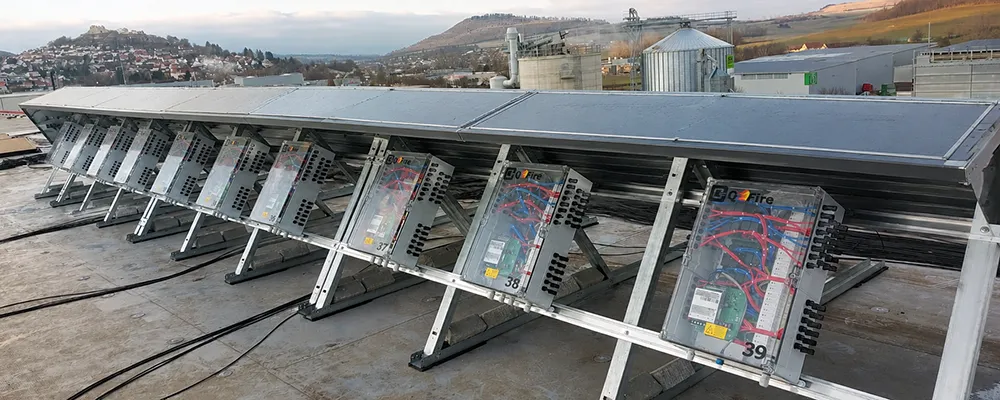
For commercial rooftop systems, public buildings, multiple roof areas or long DC cable routes, a simple assessment of whether a firefighter switch is required is often not enough. The generator disconnection must be technically suited to the specific PV system.
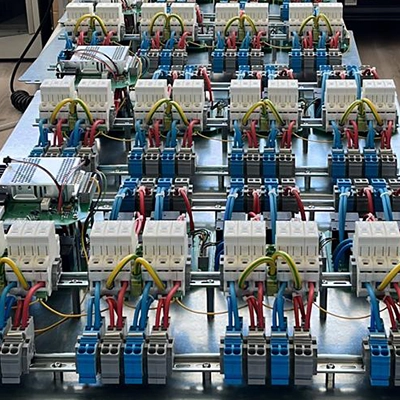
The QFire BIG firefighter switch was developed for larger and commercial PV systems. It enables generator-side DC disconnection of PV strings, is designed for systems up to 1,500 V DC and can be planned project-specifically – for example with surge protection, external emergency stop, key switch, status indication or cluster solution.
About the author
Thomas Neumann, Managing Director of Q3 ENERGIE GmbH & Co. KG, is a recognised specialist in disconnection technologies for photovoltaic systems. The company has been developing and distributing innovative solutions designed to increase the safety of PV systems since 2011. With more than a decade of experience, Q3 is one of the industry’s pioneers and sets standards for the safe operation of photovoltaic systems. His expert article “When is a firefighter switch mandatory for a PV system?” can also be found on Wikipedia.

Technology
Firefighter Switches

Learn how the QFire firefighter switch works, why galvanic isolation according to IEC 60947-3 is essential, and which technical solutions are available for safe PV systems.
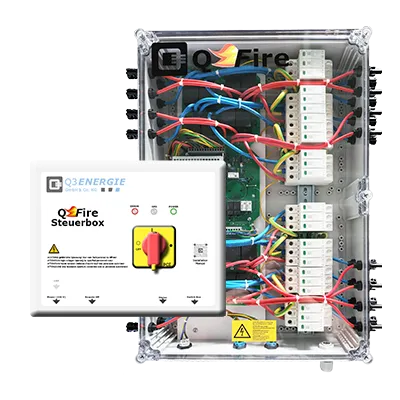
QFire BIG
Firefighter Switch
Generator-side disconnection for larger PV systems with up to 24 PV strings per box and optional accessories. Project-specific planning with a central, cascadable shutdown system.
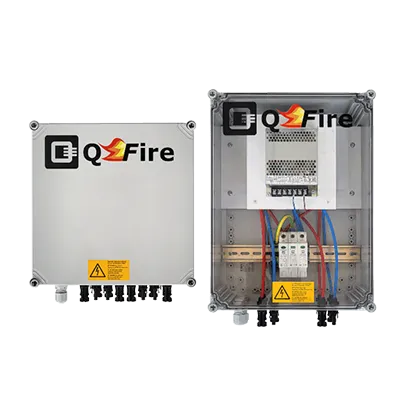
QFire LITE
Firefighter Switch
Compact string disconnection in accordance with IEC 60947-3 for smaller PV systems. A standardised, cost-effective solution for up to 4 strings, designed for straightforward installation.

FAQ
Frefighter Switches

In our FAQ, we answer the most common questions about regulations, standards, fire protection, function, installation and typical applications of PV firefighter switches – clearly and practically.

Technical Articles and Industry News About PV Firefighter Safety Switches
The use of firefighter switches in photovoltaic systems is the subject of ongoing discussion within the industry – particularly in relation to safety, mandatory requirements, standards and their role in the event of a fire. Here you will find selected technical articles, industry reports and technical assessments.