


AC Connection Box for PV Systems
Technology, Design and Standards-Compliant Engineering
AC connection boxes ensure the safe feed-in, distribution and protection of AC circuits in photovoltaic systems – from the inverter to the grid connection point.
On this page
What Is an AC Connection Box?
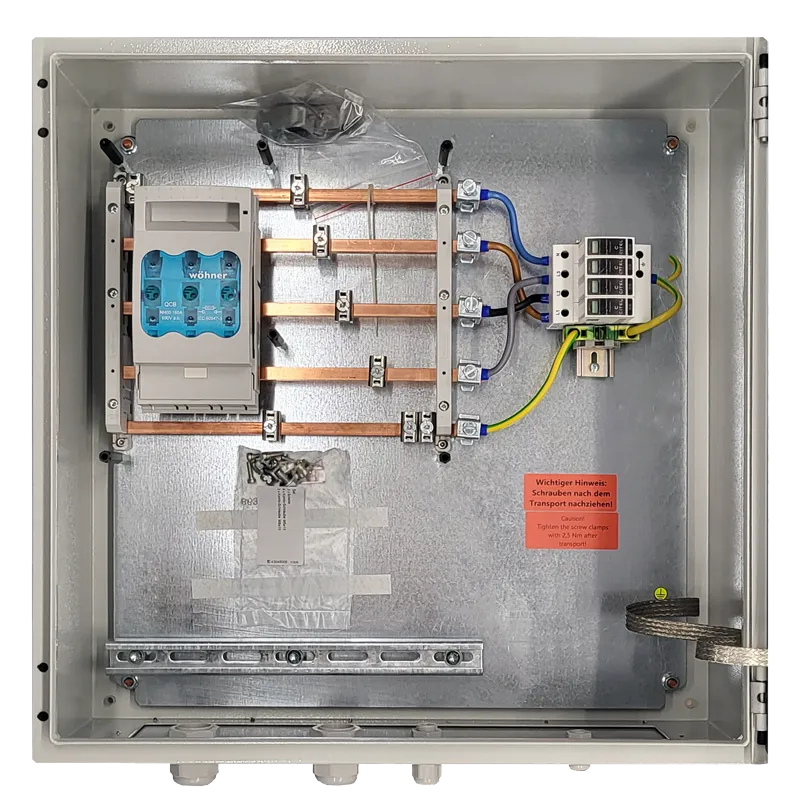
An AC Connection Box forms the defined interface between the inverter and the low-voltage grid or building installation. It combines protection, switching, and distribution functions in a standards-compliant switchgear assembly according to EN 61439.
In contrast to DC connection technology on the generator side, the AC box handles the grid-side integration of the PV system. It ensures that current, voltage, and the protection concept are correctly adapted to the existing infrastructure.

Typical Applications
AC Connection Boxes are particularly used in:
Commercial and industrial
PV systems
Storage integration
on the AC side
Central
inverter concepts
Defined grid connection points
according to VDE specifications
Multiple inverters
with common grid feed-in
They can be designed as pure feed-in boxes, as collection boxes for multiple inverters, or as transfer points to the main distribution board.
Secure Connection between Inverter and Grid
In photovoltaic systems, AC Connection Boxes perform the central task of connecting inverters safely, in compliance with standards, and in a maintenance-friendly manner to the low-voltage grid, the grid transfer point, or the transformer. They bundle high AC currents, integrate protection and switching devices, and create a clear, defined interface between generation and the grid.
Q3 ENERGIE‘s AC connection technology is designed for use in commercial, industrial, and grid-connected PV applications and is planned, constructed, and tested as a low-voltage switchgear assembly according to EN 61439.

Functions of an AC Connection Box in a PV System
AC Connection Boxes fulfill several safety- and operation-relevant functions within the PV system:
They do not replace a building’s sub-distribution, but rather form a powerful interface specifically designed for PV applications between generation and the grid connection point.
Design of an AC Connection Box
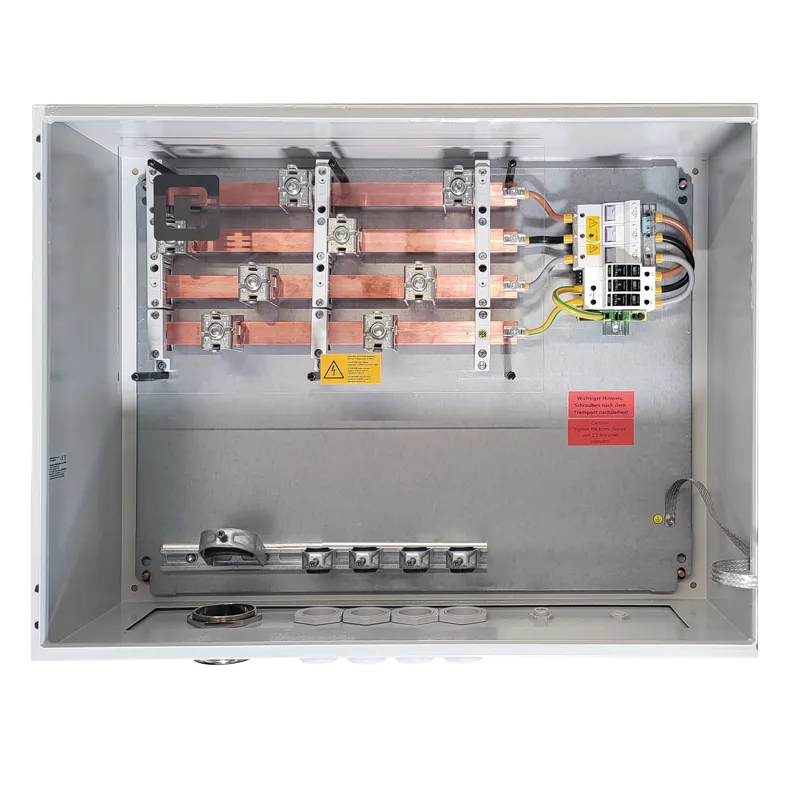
The specific structure is project-specific; typical components include:
The unit is designed as a low-voltage switchgear and controlgear assembly in accordance with EN 61439-1 / -2.
Where a complete AC distribution board is not required, AC-side surge protection can also be implemented separately as a compact protection box – for example with the Q3 SurgeBox TN-S Compact for TN-S networks.
Technical Design Criteria
The dimensioning of an AC connection box is based on:
Rated current of the inverter
or feed-in power
Grid type
(TN-S, TN-C, TT)
Short-circuit power at the grid connection point
Selectivity to upstream protective devices
Rated voltage
(e.g., 400 V AC)
Thermal load capacity of the busbars
Correct design considers both continuous current and potential short-circuit currents and their breaking capacity.

Grid Types and Protection Concepts
The configuration of the AC connection box is largely determined by the existing earthing system:
The protection concept defines:
Especially for systems with high feed-in power, considering short-circuit withstand capability is mandatory.
Surge Protection on the AC Side
On the AC side, overvoltages arise, among other things, from:
Q3 AC Connection Boxes can be equipped with surge protective devices of types 1+2 or 1+2+3. Integration is close to the current path and coordinated with the respective grid type. Remote signaling contacts for status monitoring can be optionally integrated.
Compact solution for TN-S networks: Q3 SurgeBox TN-S Compact
For applications where a complete AC distribution board with busbars, switch-disconnectors or feed-in function is not required, the Q3 SurgeBox TN-S Compact provides a compact surge protection box for TN-S networks.
The box combines AC-side surge protection Type 1+2+3, an integrated fuse/disconnector unit, plug-in protection modules, optical status indication and a prepared remote signalling contact in a ready-to-connect polycarbonate enclosure.
Normative Requirements
For AC connection boxes, the following requirements are particularly relevant:
Compliance with these standards ensures electrical safety and conformity with applicable technical regulations.
Standardized or System-Specific Solution?
AC connection boxes can be supplied as standardised variants or manufactured on a project-specific basis.
For customized designs, the following are adapted:
to the respective project requirement.
In addition to large AC connection boxes for PV and storage projects, we also offer compact AC protection solutions for defined applications. The Q3 SurgeBox TN-S Compact is a standard configuration for AC-side surge protection in TN-S networks and can be adapted on a project-specific basis where required.

How a Q3 AC Connection Box Is Developed
Each Q3 AC connection box is designed and manufactured on the basis of the project-specific requirements.
After reviewing the electrical key data – in particular rated current, short-circuit power, earthing system and protection concept – the technical dimensioning is carried out for:
■ Busbars and conductor cross-sections
■ Switching and protective devices
■ Surge protection
■ Enclosure size and degree of protection
The design is carried out according to EN 61439 as a tested low-voltage switchgear assembly.
Both thermal load capacity and selectivity, as well as mechanical requirements, are taken into account.
This results in an AC Connection Box that is not only standards-compliant but also precisely tailored to the respective system structure.
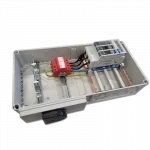
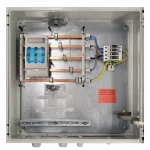
1. Mechanical Base and Mounting Plate
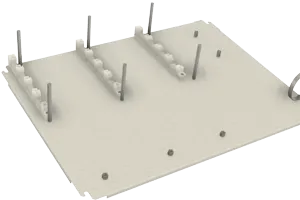
Stable mounting plate with defined fastening, insulation, and grounding points as a basis for busbars, terminals, and switchgear.
2. Busbar System Assembly
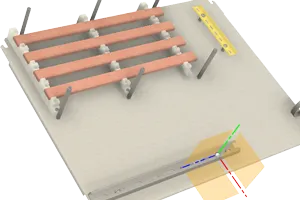
Installation and dimensioning of solid copper busbars according to rated current, grid type, and short-circuit withstand capability.
3. Connection Terminals and Cable Outlets
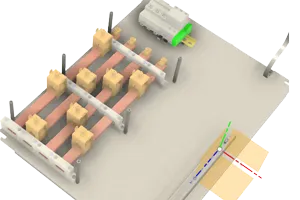
Integration of high-performance connection terminals for preparing inverter and transformer connections for large conductor cross-sections.
4. Integration of Protective and Switching Devices
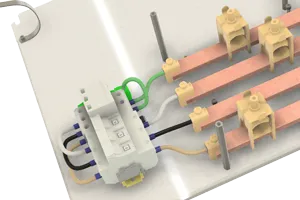
Integration of NH load disconnectors and surge protective devices directly in the defined current path.
5. Protection Against Accidental Contact and Electrical Safety
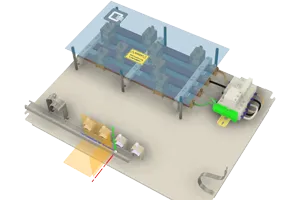
Covering active parts with transparent protective covers according to IP2X/IPXXB for safe operation and maintenance.
6. Cable Entry and Strain Relief
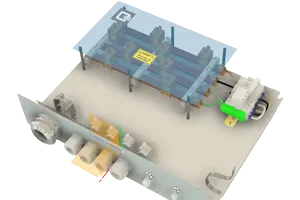
Preparation of cable entries with suitable glands and mechanical strain relief.
7. Installation in the Enclosure
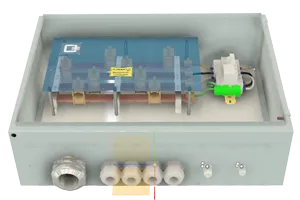
Installation of the equipped mounting plate into the IP66 enclosure for indoor or outdoor use, including door grounding.
8. Testing and Documentation
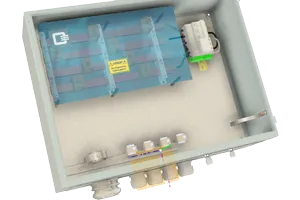
Routine test according to EN 61439, labeling, and complete technical documentation.
Distinction from DC Connection Technology
While DC connection boxes relate to the string level of the PV generator, AC connection technology operates on the AC side after the inverter. Accordingly, the following differ:
Both systems complement each other and together form a safe overall system.
AC Connection Box Project Request
Would you like to design an AC connection box for a specific project, have technical details reviewed or select the right configuration for your photovoltaic or storage system?
Using the inquiry form below, we collect all relevant project data in a structured and transparent manner.
You are welcome to send circuit diagrams, grid requirements, protection concepts, or other technical documentation directly. Based on this, we review the electrical parameters, dimension busbars, protective devices, and connection points, and design the AC Box to match your project.

Project Request
AC Connection Box

Project-specific design of AC connection boxes for grid connection, feed-in points, and storage solutions.

Technical Documentation AC Boxes

Data sheets, circuit diagrams, certificates, and technical documentation for AC distribution and transfer points.

Q3 AC-
Anschlussboxen

Overview of standardized and customized AC boxes for various grid types and power ranges.
Q3 SurgeBox
TN-S Compact
Compact Type 1+2+3 surge protection box for TN-S networks – ready to connect.