

PV Firefighter Switch: PV Generator Disconnection for Photovoltaic Systems
Technical explanation of safe PV generator disconnection – from DC string disconnection to optional AC-side shutdown logic.
On this page
What is a PV Firefighter Safety Switch?
A PV firefighter safety switch is a safety device designed to selectively disconnect photovoltaic DC circuits at string level. It is intended to protect firefighters, emergency responders and service personnel, particularly during fires or rescue operations in buildings equipped with photovoltaic systems.
Because PV modules continuously generate DC voltage when exposed to light, the DC cables between the generator field and the inverter remain live even after the AC side has been switched off.
String-level shutdown groups several modules together and disconnects them reliably. As a result, dangerous DC voltages are no longer present from the installation point of the firefighter switch towards the inverter. This principle has proven to be technically robust, cost-effective and practical – particularly for larger and commercial PV systems.
Module-level shutdown systems are used in certain applications but usually involve increased technical effort, additional system complexity and higher costs.
Modern firefighter safety switches with string-level disconnection can be integrated into fire protection and PV planning concepts and can be triggered manually or via external control signals such as emergency stop buttons or fire alarm systems.
Selective DC string disconnection
Galvanic isolation according to IEC 60947-3
Protection for firefighters and emergency responders
Automatic or manual emergency shutdown
Modern systems such as the QFire PV firefighter safety switch support automatic and manual emergency shutdown and are designed for safe PV generator disconnection according to IEC 60947-3.
PV firefighter switch – briefly explained
A firefighter switch for photovoltaic systems disconnects PV strings on the DC side and galvanically isolates them from the inverter in the event of activation. The aim is to de-energise the DC cables from the installation point of the switching unit towards the inverter.
PV modules can continue to generate voltage when exposed to light. Generator-side disconnection therefore reduces dangerous DC voltages inside the building or along long cable routes. Modern systems such as QFire are designed according to IEC 60947-3 and can be triggered automatically, manually or via external control signals, depending on the system design.
Why PV Systems Need Emergency DC Shutdown?
Photovoltaic systems can generate DC voltages of up to 1,500 V. Even when the inverter is switched off, the DC string cables may remain live.
In emergency situations, this can:
Complicate rescue operations
Endanger firefighters and emergency responders
Delay firefighting operations
A firefighter safety switch enables galvanic disconnection of the PV strings directly at the building entry point or close to the roof entry.
The challenge of DC voltage: photovoltaic systems continuously generate voltage when exposed to light.
Disconnecting the AC side alone does not automatically make a PV system DC-safe.
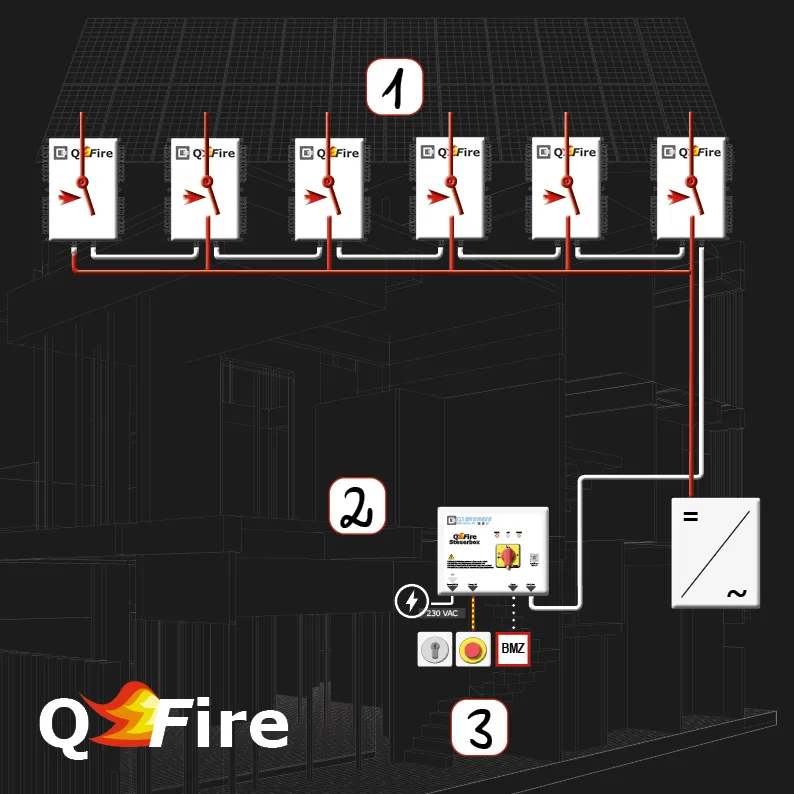
How Does a PV Firefighter Safety Switch Work?
A firefighter safety switch disconnects the PV strings automatically or manually from the inverter by galvanic isolation in emergency situations. Typical system components include:
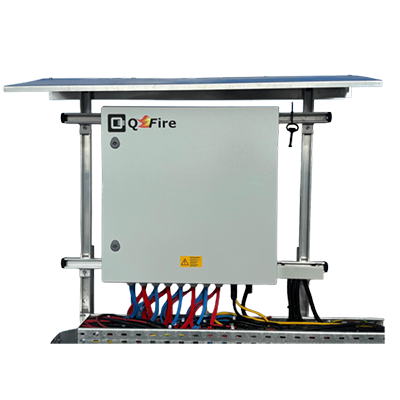
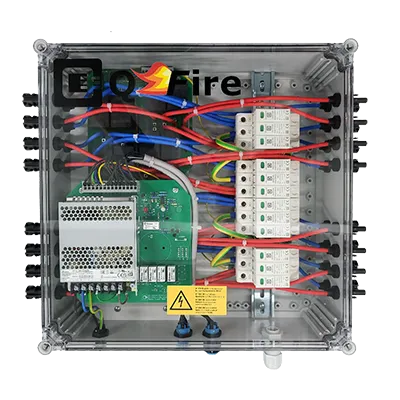
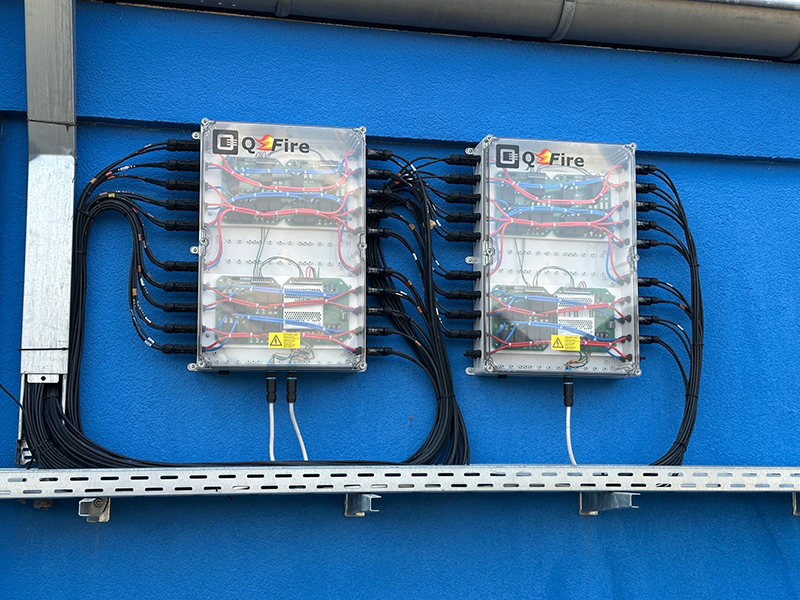
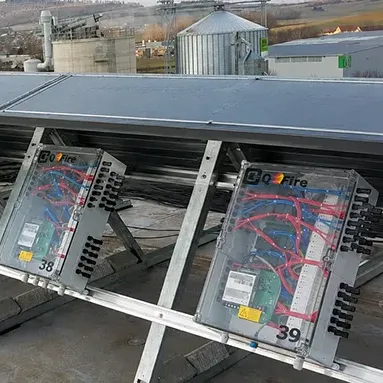
[1] Switch Boxes installed close to the roof entry point
[2] Control Box located in the inverter area
[3] Optional external emergency stop and interface to the fire alarm system
Optional components include:
■ integration of a fire alarm system
■ integrated surge protection
■ integrated fuses in the positive and/or negative pole
■ cluster technology for multiple roof areas
■ integration into an AC-side shutdown concept
In the event of shutdown, all PV strings are galvanically isolated so that the cables between the firefighter safety switch and the inverter become de-energised.
Flexible integration for different photovoltaic system concepts – from small commercial installations to large-scale PV systems with multiple generator fields.
Technical Requirements for Modern PV Firefighter Safety Switches
Modern firefighter safety switch systems must meet a wide range of technical requirements:
Certified according to IEC 60947-3
System voltages up to 1,500 V DC
String currents up to 20 A per string
Safe shutdown without arcing – through galvanic isolation
Robust enclosures for outdoor installation (IP66/IP67)
Integration of surge protection and/or string fuses
Q3 PV firefighter switch QFire LITE | BIG at a glance
| Requirement | QFire LITE | QFire BIG |
|---|---|---|
| System type | smaller to medium-sized PV systems | larger commercial PV systems |
| System design | compact standard solution | central Control Box with Switch Boxes |
| Expandability | standardised, not cascadable | modular and cascadable |
| Triggering | e.g. grid failure, external signal, emergency stop | grid failure, emergency stop, Control Box, FAS/FACP |
| Typical application | simple rooftop systems, smaller commercial systems | large rooftops, multiple roof areas, public buildings, industrial sites |
| Planning | standardised | project-specific |
| Link | View QFire LITE for smaller PV systems → | View QFire BIG for large PV systems → |

Basic Principle of DC-Side Shutdown
In photovoltaic systems, DC voltage is generated directly within the PV generator. This means that DC cables can remain critical even when only the AC supply has been disconnected.
QFire addresses this issue by disconnecting the PV strings at string level close to the roof entry point or near the PV modules. The goal is to safely de-energise the cables between the switching unit and the inverter in the event of emergency shutdown.
Advantages of this principle
DC-side shutdown directly within the PV system
Galvanic isolation of all PV strings
Reduction of dangerous DC voltage during fire emergencies
Shutdown close to the roof entry point or near the PV modules
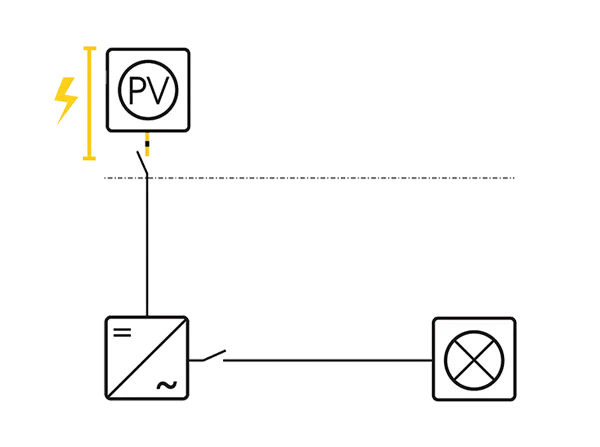
The QFire PV firefighter safety switch is designed for safe DC-side shutdown of photovoltaic systems. Unlike purely AC-side shutdown concepts, the DC voltage generated by the PV system is disconnected directly at the source.
This helps prevent dangerous DC voltage from continuing to enter the building through the string cables during fire or emergency situations.
Shutdown is achieved through galvanic isolation of all active conductors (positive and negative) for each PV string. After activation, the PV strings are de-energised so that no dangerous DC voltage remains on the cables or at the inverter inputs.
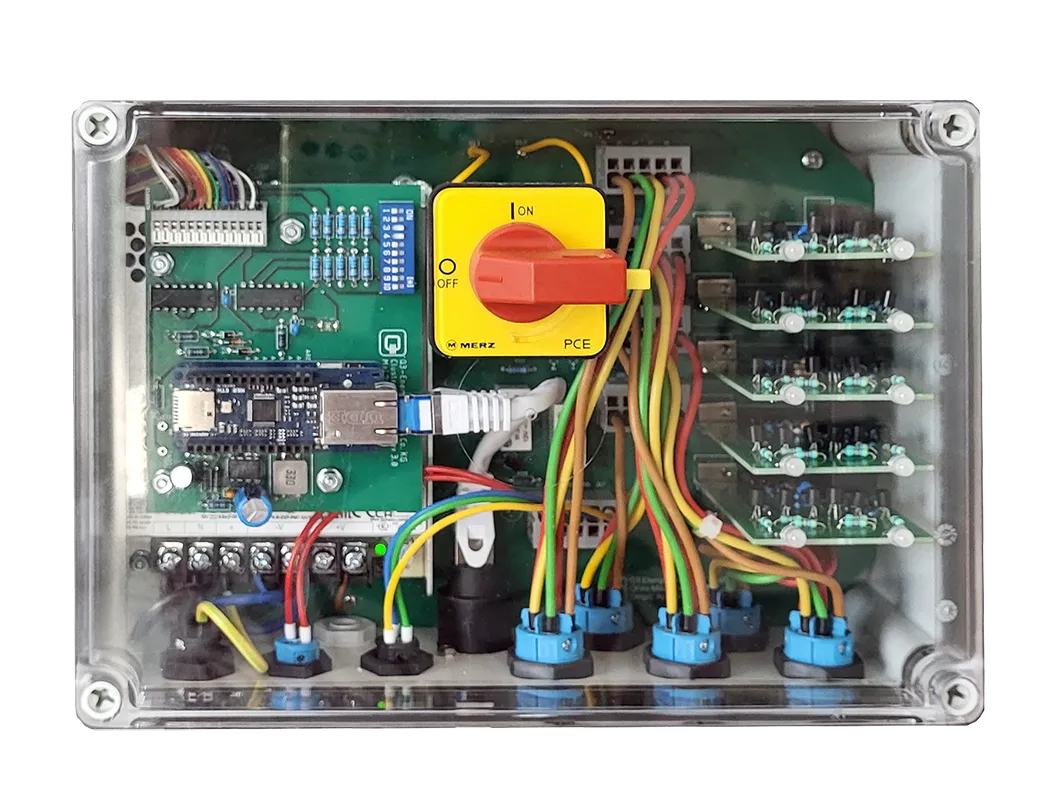
Galvanic Isolation of PV Strings
In the event of emergency shutdown, the QFire PV firefighter safety switch disconnects all connected PV strings galvanically and on both poles according to IEC 60947-3. Both the positive and negative conductors of each string are reliably isolated from the inverter to maximise safety during fire and emergency situations.
Clear distinction from motor switch solutions
Two-pole disconnection of positive and negative conductors
Safe interruption of the DC connection
DC-side shutdown directly at string level instead of AC-side isolation only
Suitable for system voltages up to 1,500 V DC and string currents up to 20 A
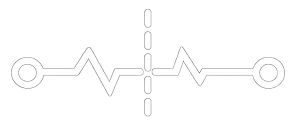
Galvanic isolation completely interrupts the electrical connection between the PV generator and the inverter. After activation, the cables downstream of the QFire switching unit are de-energised. This principle significantly reduces DC-related hazards during fire emergencies and helps maximise safety for firefighters, emergency responders and service personnel.
This shutdown principle significantly improves safety during fire and emergency situations by reliably interrupting dangerous DC voltage. At the same time, galvanic isolation remains effective regardless of the PV system configuration, string length or the number of connected generator fields.
Safe triggering in the event of fire or fault:
Shutdown mechanisms for PV firefighter switches in emergency and fault scenarios
Multiple triggering methods ensure reliable shutdown in emergency situations — manually, automatically or via external control signals.
The QFire firefighter safety switch can be triggered in several different ways. In addition to manual shutdown via the control unit or external emergency stop buttons, the system also responds automatically to defined fault conditions.
In the event of grid failure or undervoltage, the relays automatically open and galvanically disconnect the connected PV strings from the inverter. This ensures that the safety function remains active even if the supply voltage fails.
The system also detects cable breakage or voltage drops within the control circuit and automatically initiates a safe shutdown.
Manual shutdown via main switch
External emergency stop or key switch
Automatic shutdown in case of grid failure
Undervoltage detection
Cable break monitoring
Potential-free interfaces for fire alarm systems
Fail-safe principle
If the supply voltage fails or the control cable is interrupted, the QFire PV firefighter switch automatically shuts down and galvanically isolates the PV strings from the inverter.
This fail-safe principle increases safety in the event of fire and minimises the risk of cables remaining unintentionally live.
Emergency Shutdown Options for the QFire PV Firefighter Safety Switch
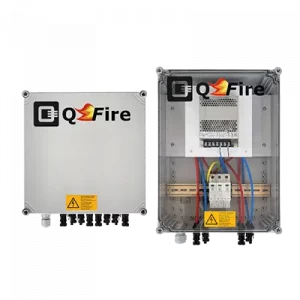
QFire LITE
QFire LITE is a standardised solution for DC-side PV string disconnection in photovoltaic systems. The shutdown is performed via the Switch Box, which is installed close to the PV modules or near the roof entry point.
The system is triggered via a simple and clearly defined control interface, for example by an external emergency stop button or control signal.
QFire BIG
QFire BIG includes a central Control Box with extended functionality for controlling the connected Switch Boxes.
The Control Box provides visual status indication and supports integration of external emergency shutdown devices as well as connection to fire alarm systems (FAS) for automatic triggering.
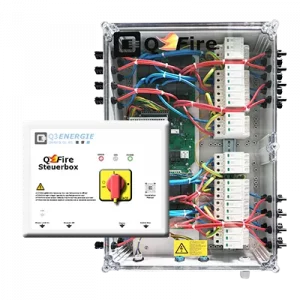
QFire LITE shutdown can be triggered by:
AC-coupled shutdown via the grid supply in case of power failure – automatic restart when the grid returns
External emergency stop
triggered by undervoltage caused by a cable break or by significant fluctuations in the AC grid
QFire BIG shutdown can be triggered by:
AC-coupled shutdown via the grid supply in case of power failure – automatic restart when the grid returns
External emergency stop
Undervoltage caused by cable breakage or strong AC grid fluctuations
Manual shutdown via the Control Box
Connection to a fire alarm control panel
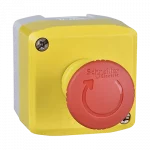
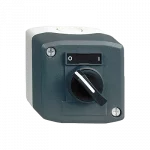
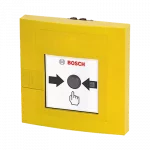
Suitable external switches for PV firefighter safety switches (emergency stop, key switch, break-glass emergency stop)
QFire BIG Control Unit – Central Control of the Firefighter Safety Switch System
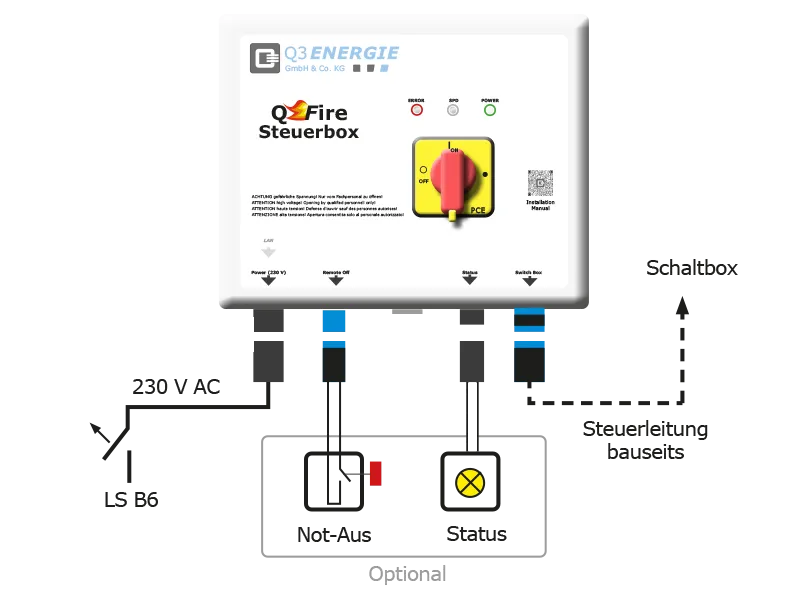
Monitoring of control signals
Status indicator
Control of individual or multiple Switch Boxes
Triggering via defined control interfaces
Potential-free interfaces for fire alarm systems (FAS/FACP)
The Control Box is the central control element of the QFire PV firefighter safety switch system. It processes incoming control signals and transmits the shutdown commands to the connected Switch Boxes in the event of activation.
Triggering is performed via a clearly defined control interface, for example through an external firefighter emergency button, a fire alarm system or an AC-coupled shutdown in case of grid failure.
The DC-side shutdown itself is performed exclusively inside the Switch Boxes. The Control Box is responsible only for safe system control and monitoring.
Cluster Control Box for Multiple Roof Areas and Generator Fields
Star-shaped connection of multiple Switch Boxes
Simultaneous shutdown of multiple roof areas or generator fields
Suitable for large and complex rooftop systems and ground-mounted PV systems
For larger photovoltaic systems with multiple roof areas or generator fields, the QFire Cluster Control Box is used. It enables central control of several Switch Boxes installed in different locations.
The Switch Boxes are connected to the Cluster Control Box in a star-shaped configuration. This allows multiple roof areas or generator sections to be shut down centrally and simultaneously.
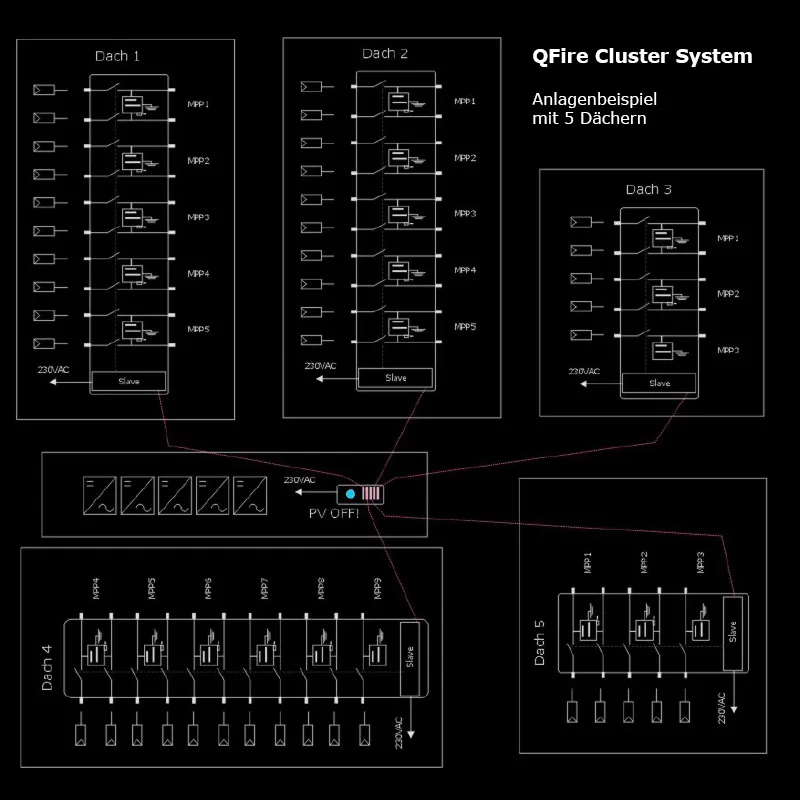
Using cluster technology, complete PV system sections or multiple roof areas can be shut down simultaneously. This is particularly advantageous for commercial, industrial and large-scale solar installations with several generator sections or feed-in points. The cluster architecture also allows flexible expansion for large and complex photovoltaic system structures.
QFire cluster system: coordinated DC shutdown of multiple generator fields
Example: five generator fields, each with its own Cluster Control Box, with common triggering via one central external emergency stop
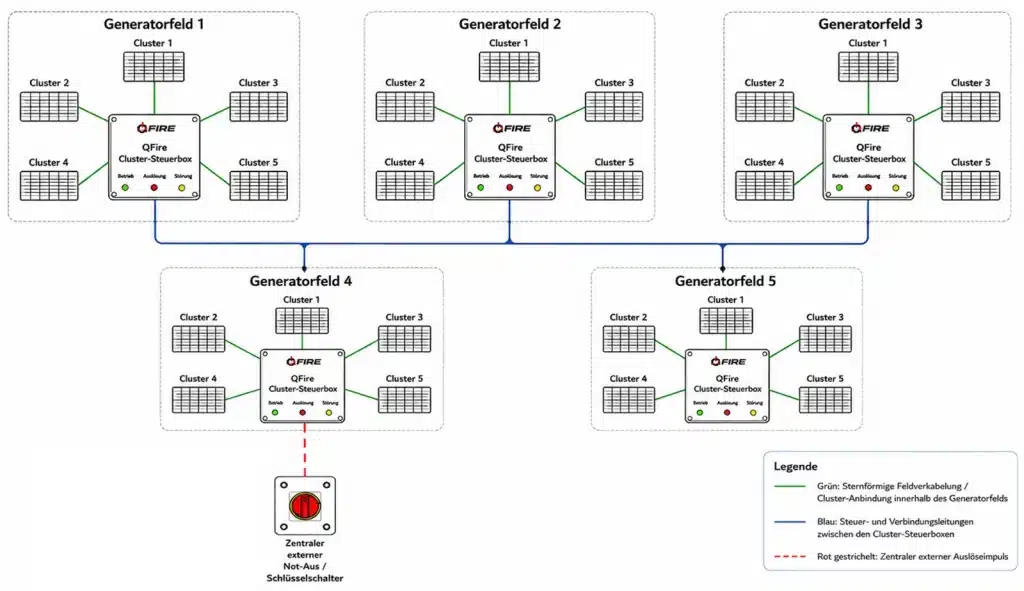
Each generator field has its own QFire Cluster Control Box. Each Cluster Control Box connects five clusters within the field in a star-shaped configuration.
All five Cluster Control Boxes are interconnected and can be triggered together via one central external emergency stop.
A central external emergency stop / key switch can trigger all connected Cluster Control Boxes together. DC disconnection is then carried out within the respective generator fields.
The Switching Unit – DC-Side PV String Disconnection
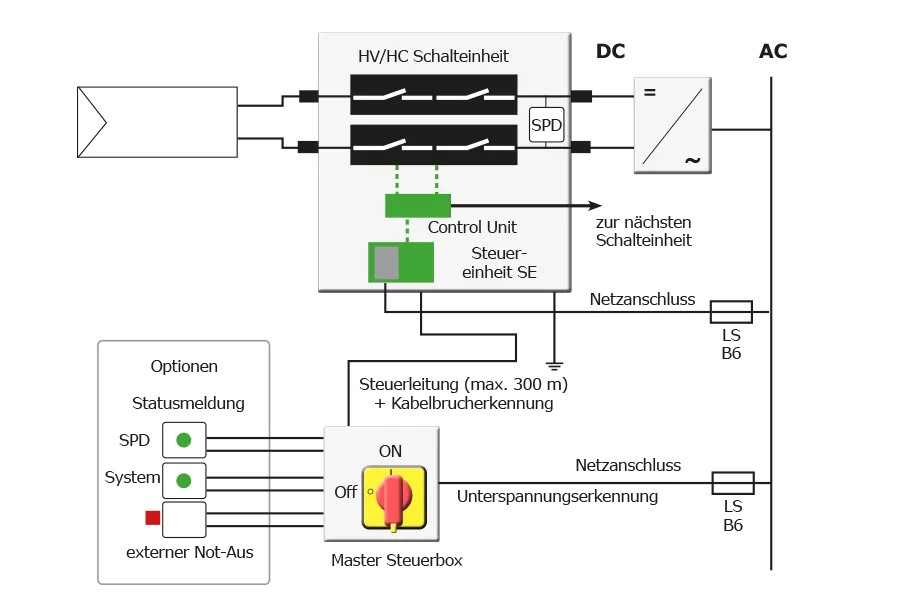
Two-pole galvanic isolation of the positive and negative conductors of each PV string
Designed for PV systems up to 1,500 V DC and 20 A per string
Optional integrated surge protection and/or integrated fuses in the positive and negative poles
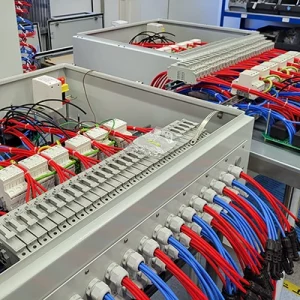
Depending on the configuration, multiple PV strings can be integrated into a single Switch Box. Optional surge protection modules can also be included to provide additional protection against transient overvoltages.
The Switch Box performs the actual DC-side shutdown of the PV strings. Each string is galvanically isolated on both poles so that no dangerous DC voltage remains at the output of the Switch Box after activation.
Standards and Regulations for PV Firefighter Safety Switches
The requirements for shutdown devices in photovoltaic systems are based on various standards and technical regulations. Important references include:
■ DIN VDE 0105-100 – Operation of electrical installations
■ VDE-AR-E 2100-712 – Fire safety for photovoltaic systems
■ IEC 60947-3 – Switches, disconnectors and switch-disconnectors for low-voltage applications
PV firefighter safety switches must reliably provide galvanic isolation of the photovoltaic system so that no dangerous voltage remains on the cables after shutdown.
Normative Framework
Technical guidance is based, among other things, on VDE regulations such as DIN VDE 0100-712 and VDE-AR-E 2100-712, as well as recommendations issued by fire services for operations involving photovoltaic systems.
For the switching devices themselves, the requirements of IEC 60947-3 are particularly relevant, as this standard defines the safe switching and isolation functions of switch-disconnectors.
What is important when planning a PV firefighter switch?
When planning a firefighter switch for PV systems, the number of strings is not the only decisive factor. Cable routes, roof entry points, inverter structure, MPPT allocation, surge protection, possible fire alarm systems, external emergency stop points and the question of whether several roof areas or generator fields need to be shut down together are also important.
For smaller systems, a standardised solution such as QFire LITE may be sufficient. For larger commercial systems, public buildings, multiple roof areas or complex shutdown concepts, project-specific planning with QFire BIG is usually the better choice.

Frequently Asked Questions About PV Firefighter Safety Switches
Plug & Play Installation of the QFire PV Firefighter Safety Switch
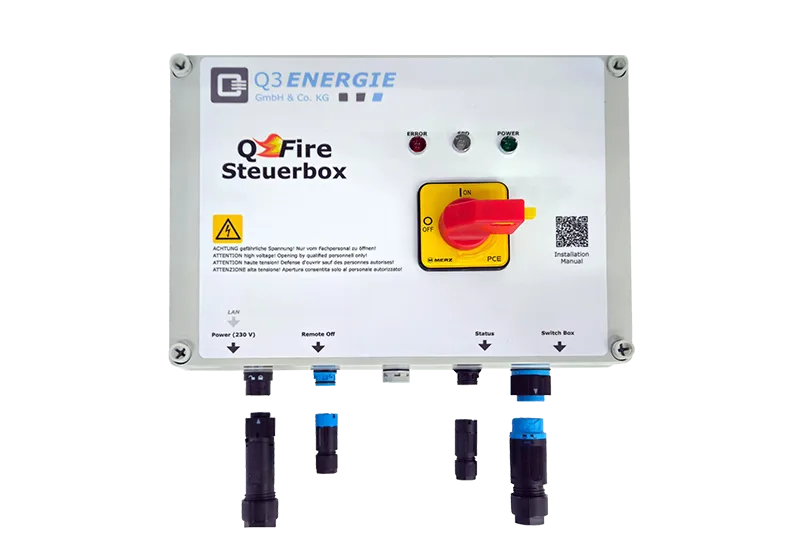
Easy installation: no internal wiring of the control cables to terminal blocks required
Reduced installation effort: matching plug connectors supplied
Reduced risk of installation errors through clearly defined plug connections instead of individual terminal wiring
Project-specific configuration: connections adapted to the individual system layout
QFire systems are equipped with a plug-and-play connection concept designed to simplify and accelerate installation of the PV firefighter safety switch system. A key feature of this solution is the use of project-specific pre-wired connectors on both the Control Box and the Switch Boxes.
This connector-based installation concept significantly simplifies on-site assembly. Only the grid connection and grounding still require internal wiring. As a result, installation times are reduced, wiring errors are minimised and installation reliability is increased — especially in larger photovoltaic systems with multiple Switch Boxes.
.
Time-Delayed Shutdown for Large-Scale and Megawatt PV Systems
Optimised shutdown logic for large photovoltaic systems
Time-delayed shutdown of large generator fields
Adjustable delay times between 1 and 10 seconds depending on system size
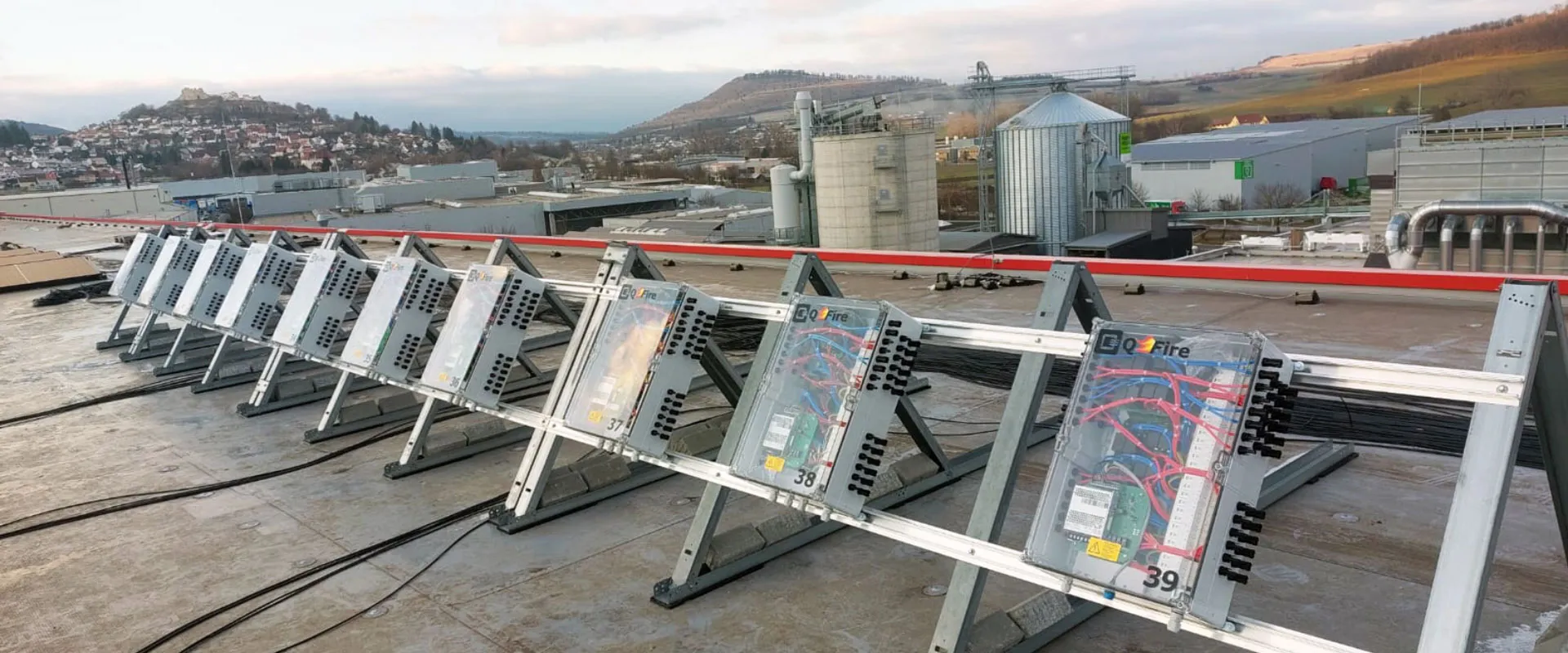
For very large photovoltaic systems with high installed capacity, a time-delayed shutdown sequence can be beneficial. The QFire control system can be configured so that individual generator fields or Switch Boxes are shut down sequentially with a defined time delay.
This staged shutdown process helps reduce electrical and mechanical stress and ensures controlled shutdown behaviour in large-scale photovoltaic installations.
Application Example – QFire LITE PV Firefighter Safety Switch for Facade PV Systems on High-Rise Buildings
High-rise photovoltaic systems with string-level shutdown for each floor
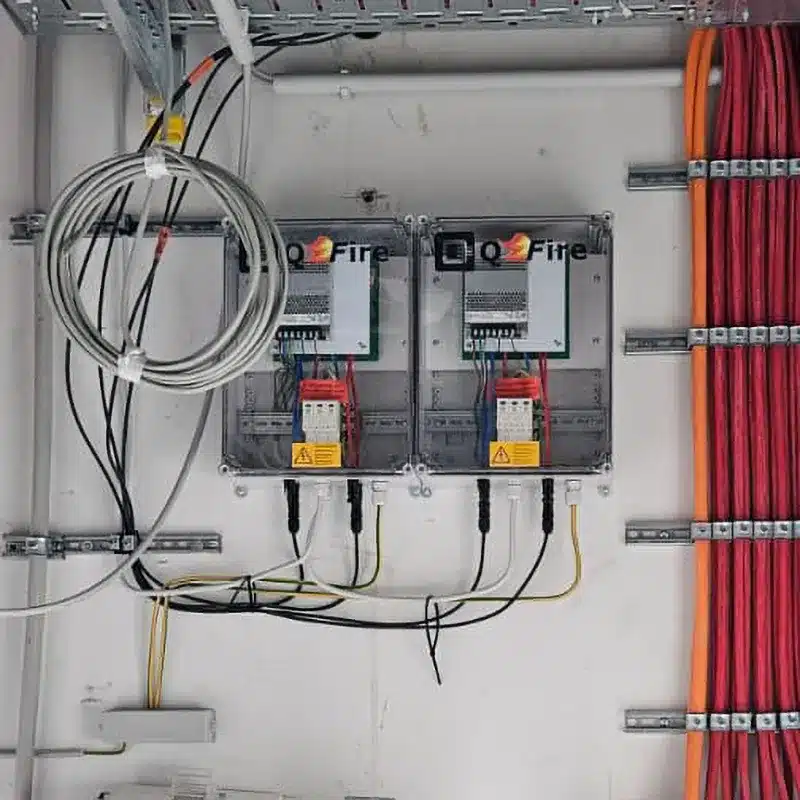
Photovoltaic systems installed on high-rise buildings, where individual PV strings are routed separately along the facade and into the building for each floor, create special requirements for DC-side safety and shutdown concepts.
In such applications, insurers and fire services often require a clearly defined, reproducible and automatically effective shutdown solution in case of fire emergencies. The QFire LITE firefighter safety switch is particularly suitable for these types of installations.
Typical project requirement
■ One PV string per floor with separate building entry point
■ Different string grouping at the inverter
■ High requirements for personal and operational safety
■ Central shutdown option for the fire service
■ Standards-compliant implementation in accordance with applicable DC switching and fire protection requirements
Solutions for Different Types of Photovoltaic Systems
PV firefighter safety switches can be integrated into a wide range of photovoltaic system concepts, including:
■ Commercial photovoltaic systems
■ Industrial and ground-mounted solar installations
■ Rooftop photovoltaic systems with multiple inverters
The modular QFire system enables safe shutdown of everything from small commercial PV systems to complex large-scale photovoltaic installations with multiple generator fields.

Who Is the QFire BIG System Designed For?
PV planners and consulting engineers
Installers and EPC companies
Operators of large-scale photovoltaic systems
The QFire system was specifically developed to meet the requirements of planners, installers and EPC companies.
Thanks to its modular architecture, clearly defined system logic and simplified installation concept, the system can be integrated into a wide variety of photovoltaic system designs in compliance with applicable standards.
The combination of technical safety, scalability and easy handling makes QFire a future-proof solution for photovoltaic systems of all sizes.
Who Is the QFire LITE System Designed For?
Installers and specialised electrical contractors
Planners of smaller photovoltaic systems
Electrical wholesalers and distribution partners
The QFire LITE system is the standardised solution for small and medium-sized photovoltaic systems. It is based on the same proven safety principle as QFire BIG, but designed as a compact, non-expandable solution.
QFire LITE is particularly suitable for straightforward photovoltaic system concepts where simple integration, a limited number of strings, clear system structures and cost-efficient implementation are key priorities.
Combined DC and AC shutdown for large PV systems
In large PV systems, industrial projects and solar parks, the shutdown concept often has to be considered beyond the DC side alone. In practice, it may be necessary to disconnect the PV strings on the DC side close to the generator and, at the same time, shut down or block the AC side of the inverter or the feed-in path in a controlled manner.
QFire BIG can be integrated into such an overall shutdown concept. The QFire switch boxes provide generator-side galvanic isolation of the DC strings according to IEC 60947-3. In addition, the status contact of the QFire control box can be used project-specifically to provide an external AC-side shutdown signal – for example to a grid and system protection relay, an inverter enable input or a site-specific contactor solution.
This makes QFire BIG particularly suitable for large commercial PV systems, megawatt projects, solar parks, industrial buildings and hybrid systems where DC string disconnection and AC-side enable interruption should not be considered separately.
Why is combined DC and AC shutdown useful in large PV systems?
In simple PV systems, it is often sufficient to disconnect the DC cables at a defined disconnection point. In larger installations or hybrid systems, the situation can be different. If, for example, a battery storage system is connected to the inverter or to the DC link, the DC link may remain charged. In unfavourable cases, this can lead to measurable voltage between the DC string cables and earth, even though the DC-side PV generator disconnection has already been triggered.
For this reason, it can be useful or necessary in such systems to integrate both the DC side and the AC side into the shutdown concept at the same time. QFire BIG disconnects the PV strings on the DC side close to the generator. In parallel, an AC-side shutdown or enable circuit can be controlled via the status contact of the control box. This helps prevent the DC and AC side from reacting independently of each other during a shutdown sequence.
Can QFire BIG control a grid and system protection relay or inverter enable signal?
Yes. Depending on the project, the status contact of the QFire control box can be used to control external components. Typical applications include integration into a grid and system protection relay, an enable signal at the inverter or a site-specific contactor control on the AC side.
In practice, the potential-free status contact is not used as a power switch, but as a signal or enable contact. For example, it can be integrated into the enable circuit of the grid and system protection relay. When QFire is switched off, the AC-side enable can also be interrupted at the same time. The grid and system protection relay or the downstream contactor solution then performs the actual AC-side shutdown.
The exact wiring depends on the grid and system protection relay used, the inverter, the grid connection concept and the project requirements.
How does the shutdown concept work in practice?
During a shutdown, QFire BIG performs the DC-side function: the connected PV strings are galvanically disconnected at the switch box close to the generator. This disconnects the DC cables from the QFire switch box towards the inverter.
At the same time, the status contact of the control box can be used as a signal for the AC side. This signal can, for example, influence a grid and system protection relay, an inverter input or an external contactor control. In a typical setup, the grid and system protection relay then controls the AC contactors so that the feed-in path or AC path is also disconnected or blocked.
This creates a coordinated shutdown concept: on the DC side, QFire BIG disconnects the PV strings; on the AC side, the enable signal or feed-in path is interrupted via the external components provided for this purpose.
For which systems is combined DC and AC shutdown particularly relevant?
Combined shutdown is particularly relevant for larger and more complex system structures. These include commercial rooftop systems, industrial PV systems, megawatt solar parks, PV systems with several inverters, hybrid systems with battery storage, systems with a central grid connection point and projects with special requirements regarding fire safety, grid connection or operational safety.
In such projects, EPCs and planners must ensure that the shutdown does not only work at one single component, but fits the overall system concept. QFire BIG provides the DC-side PV generator disconnection and the option of integrating AC-side shutdown logic via the status contact.
What should be considered during planning?
The AC-side shutdown is not carried out directly by the QFire switch box as a power switching device. QFire BIG provides the DC-side galvanic isolation and can supply a signal for the AC-side shutdown logic via the status contact of the control box.
The design of the AC components – for example grid and system protection relay, AC contactors, inverter enable, grid connection and protection concept – is always project-specific. The specifications of the inverter manufacturer, the requirements of the grid operator, the grid connection concept and the applicable technical rules must be taken into account.
For large PV systems, combined DC and AC shutdown should therefore be considered early in the planning process. This allows the switching logic, status indication, emergency stop concept, control cable, grid and system protection relay and inverter enable to be coordinated properly.
Note on AC-side shutdown
QFire BIG does not replace the grid and system protection relay or the site-specific AC switching equipment. However, the QFire control box can provide a signal for external AC components via the status contact. The exact implementation is always project-specific and depends on the system concept, inverter specifications, grid connection conditions and the applicable local technical requirements.

Fachbeiträge & Pressemeldungen zum Feuerwehrschalter für Photovoltaik
Der Einsatz von Feuerwehrschaltern in Photovoltaik-Anlagen wird in der Branche intensiv diskutiert – insbesondere im Hinblick auf Sicherheit, Normung und Einsatz im Brandfall. Hier finden Sie ausgewählte Fachberichte, Branchenmeldungen und technische Einordnungen.

Intersolar 2026: Q3 Energie präsentiert KI-Konfigurator für Photovoltaik-Feuerwehrschalter
→
Wann ist ein Feuerwehrschalter bei Photovoltaik-Anlagen notwendig?
→
Generatorfreischaltung mit dem Feuerwehrschalter
→
Q3 PV-Feuerwehrschalter „QFire“ erhält Zertifizierung nach IEC 60947-3
→
QFire PV Feuerwehrschalter Schulung: Praxisnahe Schulung für Planer und Installateure
→Q3 YouTube Video Explains the QFire PV Firefighter Safety Switch – Safe DC-Side Shutdown in Fire Emergencies
Building insurers, authorities and fire services increasingly require automatic shutdown solutions for photovoltaic systems during fire emergencies or rescue operations. The main concern is the dangerous DC voltage that may remain present in the DC cables even after the building’s AC power supply has been disconnected.
The firefighter safety switch enables safe DC-side shutdown of the PV strings directly at the building entry point or roof entry area. The system is triggered via a defined control interface, for example by disconnecting the building power supply, using an external firefighter emergency button or through connection to a fire alarm system. During activation, the PV strings are galvanically isolated so that no dangerous DC voltage is routed into the building.
Once the power supply is restored after an emergency event, the system can automatically restart. Manual intervention at the photovoltaic system or on the roof is not required in this case. This ensures both operational safety and emergency response safety for the photovoltaic installation.
The video clearly demonstrates the operating principle of a PV firefighter safety switch in a practical application scenario.

Online Training for the QFire PV Firefighter Safety Switch
Planning and installing firefighter safety switches for photovoltaic systems requires a solid understanding of technical operating principles, applicable standards and practical implementation. The QFire training programme provides practical expertise covering DC-side PV string shutdown, system integration and typical planning and installation requirements.
The training is intended for planners, specialised electrical contractors and technical decision-makers who are responsible for specifying, installing or evaluating firefighter safety switch systems.


When is a firefighter switch mandatory?
Whether a firefighter switch is required for a PV system depends on the specific installation. Key factors include cable routes, building type, fire protection concept, regional requirements and tender specifications. For long DC cable routes inside the building or for larger commercial PV systems, generator-side disconnection is often technically advisable and frequently required in practice.

FAQ – PV Firefighter Safety Switches and Fire Protection for Photovoltaic Systems
In connection with firefighter safety switches for photovoltaic systems, technical, normative and legal questions frequently arise in practice. These topics particularly include DC-side shutdown concepts, the distinction between string-level and module-level shutdown, integration into fire protection concepts and the question of whether firefighter safety switches are mandatory.
As there is no universal legal requirement, the use of firefighter safety switches often depends on the specific application, the photovoltaic system design, the responsible authorities and applicable standards or recommendations. The following questions and answers are intended to provide professional guidance and address common uncertainties relating to the planning, installation and operation of photovoltaic systems.
The following FAQ section summarises the most important technical and regulatory aspects relating to firefighter safety switches for photovoltaic systems and serves as a practical guide for planning, installation and operation.

Planning & Specification
For Consulting Engineers and Planning Offices
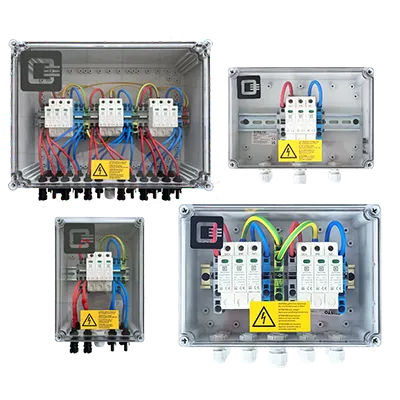
Normative guidance, planning recommendations and specification texts for firefighter safety switches in modern photovoltaic systems.
Installation & Commissioning
For Consulting Engineers and Installers
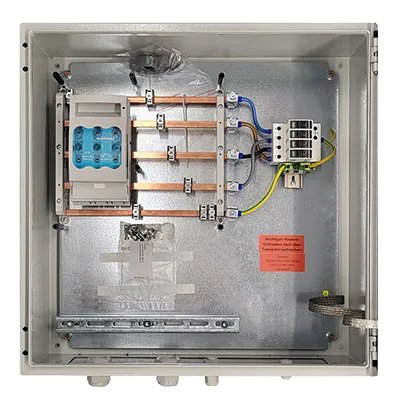
Technical fundamentals for the professional installation and commissioning of firefighter safety switches.
Produkte & Vertrieb
For Wholesalers and Distribution Partners
Overview of product variants, technical configurations and answers to frequently asked questions about PV firefighter safety switches.