Skip to content

FAQ PV Firefighter Switches | Frequently Asked Questions

In this FAQ pv firefighter switches for photovoltaic systems, we answer frequently asked questions about regulations, standards, technical requirements, safety concepts and practical implementation.
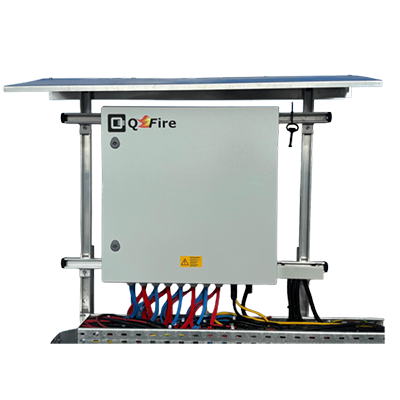
QFire Firefighter Switch Fuses in positive and negative poles Surge protection T1+2 integrated Sheet steel enclosure for industrial environments All cable entries from below — clean & protected cable handling Made in Germany — developed & built by Q3 ENERGIE

FAQ PV Firefighter Switches – General Information

Regulations & Requirements

Is a firefighter switch mandatory for photovoltaic systems?

No, there is no general nationwide requirement to install firefighter switches. Whether a firefighter switch is required depends on the building type, system size, intended use, local building regulations and the interpretation of authorities and fire services. In many projects, the requirement results from the fire protection concept or project-specific specifications.

Who decides whether a firefighter switch is required?

The decision is based on the interaction between system planning, fire protection concepts and official requirements. Relevant stakeholders may include building authorities, fire protection consultants and local fire brigades. System planners and operators share responsibility for implementing an appropriate level of risk mitigation.

Which standards are relevant for firefighter switches?

Relevant requirements can be found in various standards and technical guidelines, including DIN VDE 0100-712, VDE-AR-E 2100-712 and recommendations issued by fire services. For the switching devices themselves, IEC 60947-3 is particularly important, as it defines requirements for safe isolation and switching functions.

FAQ PV Firefighter Switches – Technology & Safety

Why can photovoltaic systems still be dangerous after the AC side has been switched off?

Even after disconnecting the AC side, the DC cables between the PV generator and the inverter remain energized whenever sunlight is present. These DC voltages cannot be eliminated by simply disconnecting the grid and may present an electrical hazard during firefighting operations or maintenance work.

Does a firefighter switch completely de-energize a PV system?

No. PV modules continue to generate voltage whenever exposed to light. However, a firefighter switch significantly reduces the hazardous area by disconnecting the DC circuits outside the generator field.

What is the difference between string-level shutdown and module-level shutdown?

With string-level shutdown, several modules are disconnected together as one string. This approach is considered technically robust, economical and practical, particularly for commercial and industrial PV systems.

Module-level shutdown allows isolation of individual modules but requires additional electronics, increases system complexity and typically results in higher costs.

What is galvanic isolation?

Galvanic isolation means the complete electrical separation of both active conductors (+ and −) of a PV string using a mechanical switching device.

Unlike electronic or grid-dependent shutdown concepts, galvanic isolation leaves no conductive connection between the PV generator and the downstream DC cabling after activation.

The QFire firefighter switch performs this disconnection directly within the switch box on the DC side, ensuring that hazardous DC voltages are no longer routed into the building during an emergency.

Why is galvanic isolation considered the safest shutdown method?

Galvanic isolation is widely regarded as the safest form of DC shutdown because it physically interrupts all active conductors of the PV string. The shutdown function remains effective regardless of grid conditions, communication signals or the operational status of other system components.

This provides reliable protection during fires, power outages or cable damage and complies with IEC / DIN EN 60947-3 requirements.

What is the fail-safe principle?

In a fail-safe system, the firefighter switch remains active only while control voltage is present. If the control voltage is lost due to a power failure or cable interruption, the system automatically disconnects the PV strings. When control voltage returns, the system can automatically resume operation.

FAQ PV Firefighter Switches – Practical Applications

What is the difference between QFire LITE and QFire BIG?

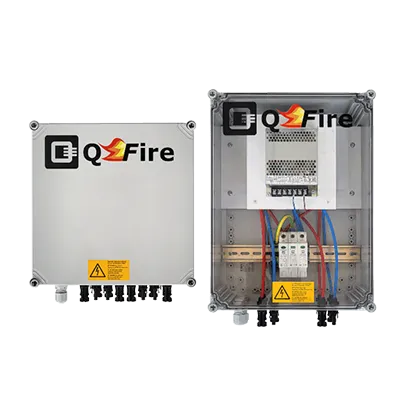
QFire LITE is a standardized solution for DC string disconnection with a simple and defined shutdown mechanism directly within the switch box. It is available for 2 or 4 PV strings, with or without integrated surge protection.

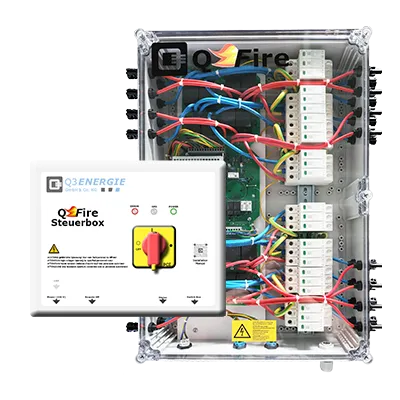
QFire BIG provides additional functionality through a central control box, including status indication, external control stations and fire alarm system integration. The system is scalable and available for up to 24 PV strings per switch box. Optional surge protection and string fuses can be integrated according to project requirements.

Can multiple roof areas be disconnected simultaneously?

Yes. QFire Cluster technology allows multiple PV generator fields or roof sections to be monitored and disconnected simultaneously. Individual strings are coordinated through the central QFire control logic and disconnected together when required.

This concept is particularly beneficial for large industrial sites, complex building structures, multiple fire compartments or extensive rooftop installations.

Can QFire be connected to a fire alarm system?

Yes. QFire BIG can be integrated into a fire alarm system (FAS). The control box enables automatic shutdown activation in accordance with the project’s fire protection concept and operational requirements.

Can external emergency stop buttons or key switches be connected?

Yes. QFire BIG supports multiple external control devices, including emergency stop buttons and key-operated switches. All shutdown commands are processed centrally through the control logic.

Why is “Made in Germany” important?

QFire is developed and manufactured in Germany. For many system operators, planners and public-sector clients, local manufacturing is an important factor regarding product quality, technical documentation, traceability and long-term product availability.

FAQ PV Firefighter Switches – QFire – Installation & Retrofitting

Can QFire be retrofitted to existing photovoltaic systems?

Yes. QFire is suitable for retrofitting existing PV installations. The firefighter switch is integrated into the DC circuit between the PV modules and the inverter. Particularly with QFire BIG, the system can be adapted to existing site conditions through project-specific engineering.

What cable lengths are possible?

Permissible cable lengths depend on the project design, conductor cross-sections and electrical system parameters. These factors are evaluated during the planning phase to ensure reliable operation.

Where is the QFire control box installed?

For QFire BIG systems, the control box is typically installed centrally, usually close to the inverter. This provides a convenient location for operation, monitoring and integration with external systems.

Where are the QFire switch boxes installed?

QFire switch boxes are installed close to the PV generator field, typically at the roof entry point where DC cables enter the building.

This arrangement minimizes the length of energized DC cables inside the building and improves safety during maintenance work and emergency situations.

How does QFire disconnect the PV strings?

QFire uses high-performance electrical relays to disconnect the DC strings. Unlike purely mechanical switching concepts, this approach enables reliable and arc-free string disconnection under photovoltaic operating conditions.

FAQ PV Firefighter Switches – QFire – Operation & Activation

What happens after the firefighter switch is activated?

Once activated, the QFire firefighter switch galvanically disconnects all connected DC strings. The shutdown process takes place inside the switch boxes and significantly reduces the hazardous area outside the PV generator field.

Does the system restart automatically?

Yes. When using the fail-safe principle, the system automatically returns to operation once the control voltage is restored and no shutdown condition remains active.

No manual intervention is required under normal operating conditions.

How does QFire differ from many other shutdown systems?

Many shutdown solutions available on the market require a manual reset directly at the modules or switch boxes after activation. This often involves roof access and opening enclosures.

Depending on the system design, QFire supports automatic recommissioning, reducing downtime and minimizing maintenance effort.

Does a firefighter switch require maintenance?

Firefighter switches generally require very little maintenance. However, as part of regular PV system inspections, visual inspections and functional testing should be carried out, particularly in safety-critical applications.

From a technical perspective, it is recommended to perform a functional shutdown test at least once per year.

FAQ PV Firefighter Switches – QFire – Technical Specifications

How many MPPTs and strings can QFire handle?

A single QFire switch box can support up to 12 MPPTs and up to 24 PV strings.

By using additional switch boxes, larger systems can be implemented. QFire systems are fully scalable and can be adapted to larger commercial and industrial PV installations.

Is QFire BIG limited to a specific system size?

No. QFire BIG is not limited to a fixed system size. Thanks to its modular architecture and project-specific design, the system can be expanded step by step to match almost any photovoltaic project.

Which connectors are supported?

QFire uses genuine Stäubli MC4-EVO 2 connectors as standard.

Upon request, the system can also be supplied with:

  • Amphenol connectors
  • Phoenix Contact SUNCLIX connectors
  • Terminal connection technology

This allows QFire to comply with existing project standards and customer requirements.

FAQ PV Firefighter Switches – QFire – Practical Example

How does QFire work in multi-storey buildings?

In multi-storey buildings, the system is typically controlled through a central AC supply. With QFire LITE, this AC voltage is looped through all floors.

If the AC supply fails during a fire or emergency, all connected firefighter switches automatically disconnect and galvanically isolate the PV strings. This minimizes energized DC cable lengths within the building and improves safety for emergency responders.

FAQ PV Firefighter Switches – Still have questions about QFire?

Contact our team for project-specific advice on firefighter switch requirements, IEC 60947-3 compliant shutdown solutions and safe DC disconnection concepts for photovoltaic systems.

Feuerwehrschalter PV Referenz Steiermark QFire Aufdachanlage
QFire Feuerwehrschalter Photovoltaik Variante BIG kundenspezifisch
QFire firefighter switch photovoltaic variant BIG customer-specific
QFire Feuerwehrschalter Photovoltaik Variante LITE standardisierte wirtschaftliche Loesung
QFire firefighter switch photovoltaic variant LITE standardized economical solution
FAQ Feuerwehrschalter