


Firefighter switches for facade PV on the M50 high-rise in Berlin-Kreuzberg
Practical example: QFire LITE firefighter switch for high-rise facade PV
At the M50 high-rise building in the Die Macherei Berlin-Kreuzberg district, a demanding facade PV system was implemented with string-level DC disconnection. For projects of this type, it is not sufficient to treat the installation as a conventional rooftop PV system. The DC cables run across several building levels, the PV strings enter the building storey by storey, and the shutdown logic must be clear, reproducible and understandable for emergency services in the event of a fire.
For the DC-side safety architecture, QFire LITE firefighter switches were used. The solution provides galvanic disconnection of the PV strings at the defined building entry point and supports a clear safety concept for facade PV, high-rise PV and building-integrated photovoltaics.
Stark umgesetzt von enprovest GmbH ⚡☀️
Firefighter Switch
Façade PV
QFire LITE
| Project data | M50, Die Macherei, Berlin Kreuzberg |
|---|---|
| Application | PV Firefighter switch for facade PV. String-level DC disconnection at the building entry point |
| Location | Hallesches Ufer, Berlin-Kreuzberg |
| Building type | High-rise building / office tower / revitalisation of the former Postscheckamt building |
| PV application | Façade PV / building-integrated photovoltaics / BIPV |
| PV area | Approx. 764 m² façade PV according to project publication |
| Technology | QFire LITE Firefighter Switch |
| Function | Galvanic disconnection of the PV strings when triggered |
| Typical triggering | ■ Central firefighter emergency stop, ■ interruption of the 230 V AC supply ■ service shutdown |
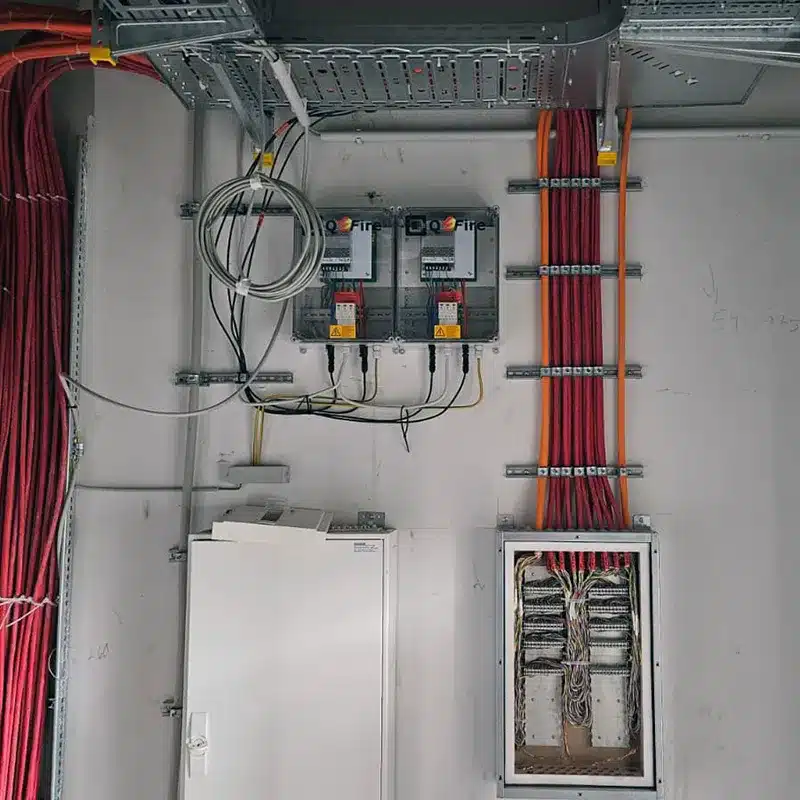
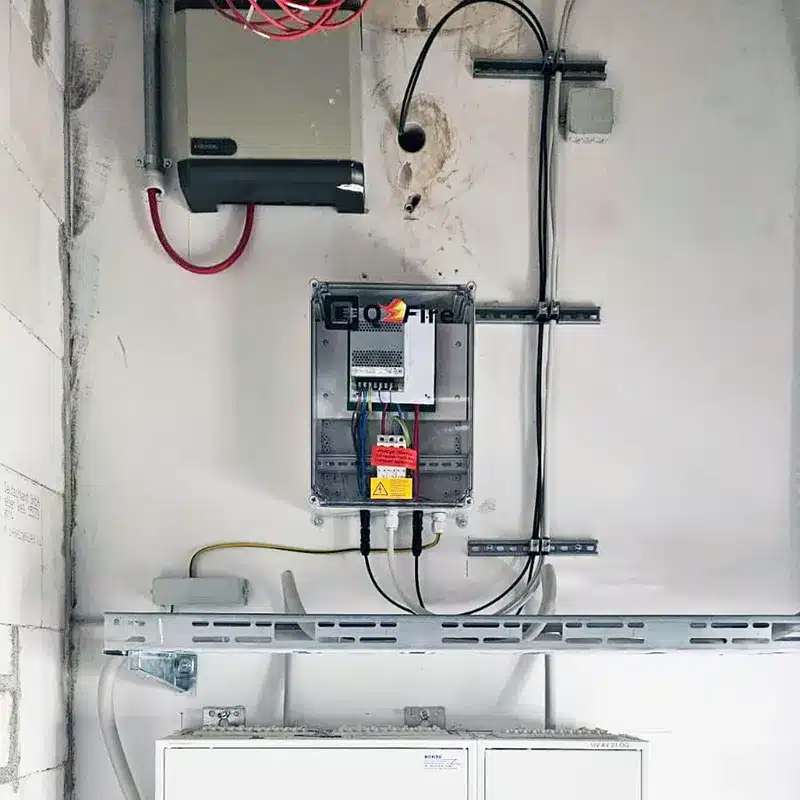
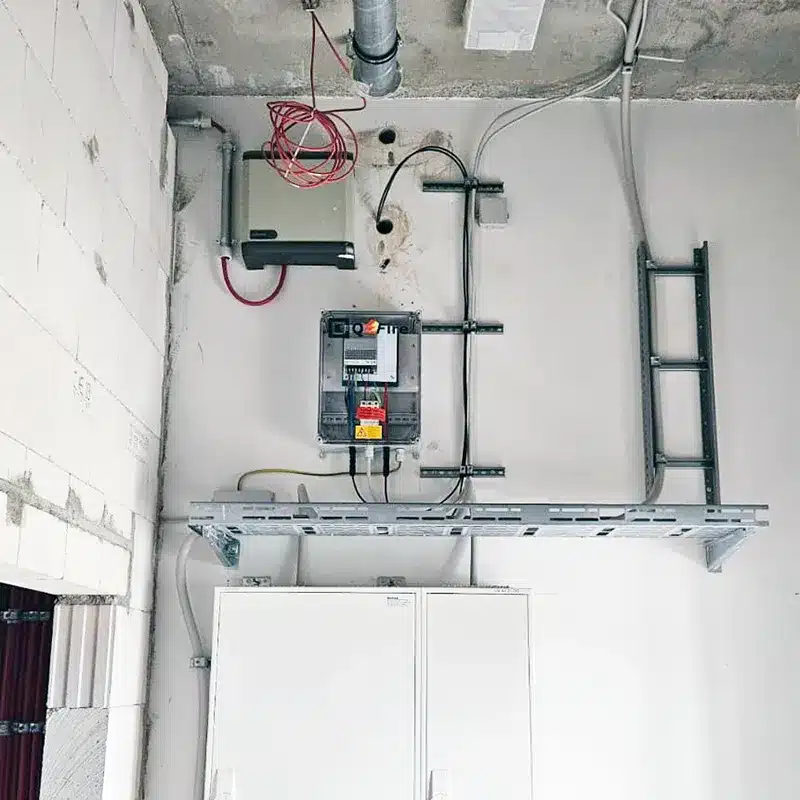
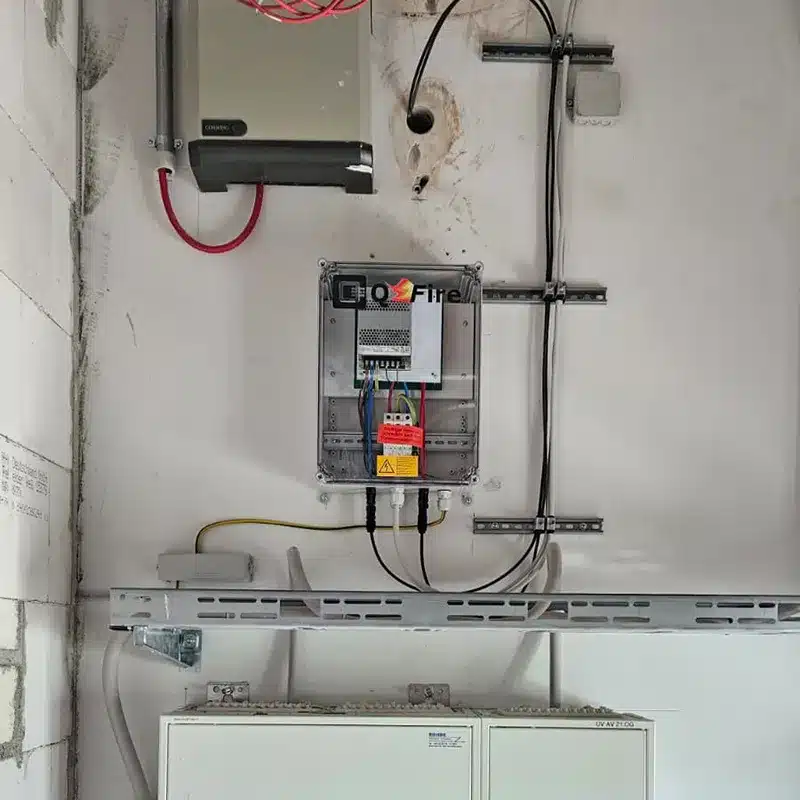
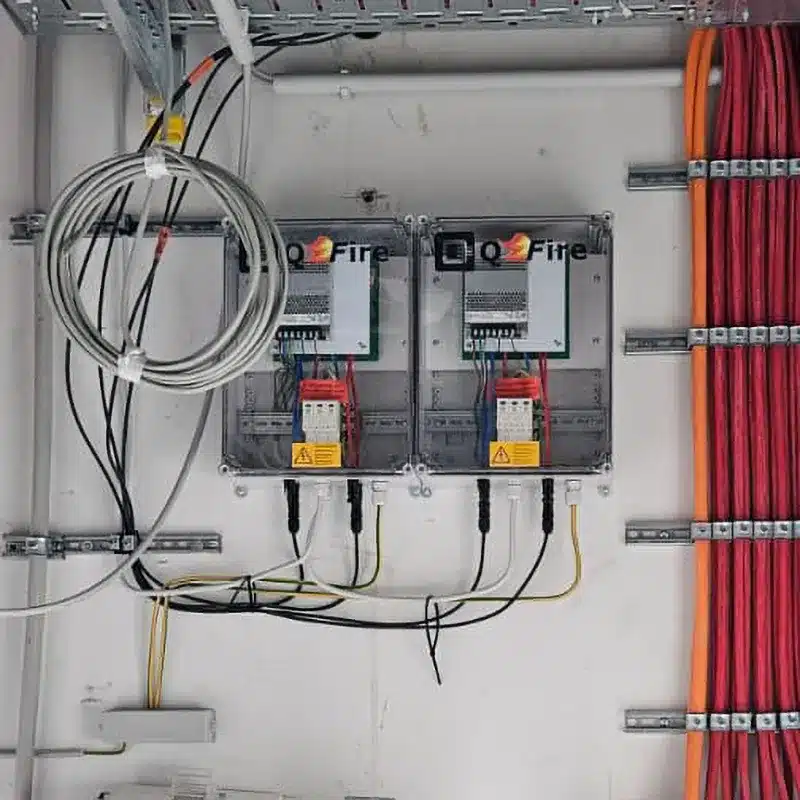
Initial situation: PV strings per storey, DC cables inside the building
In facade PV systems on high-rise buildings, PV modules are often connected storey by storey or by facade section. This creates different requirements compared with conventional rooftop PV systems.
The PV strings may enter the building separately on each storey. Depending on the inverter design, these strings are later combined at the inverter either individually, in pairs or in groups on one MPP tracker. For the fire brigade and for technical operation, it must be clear from which point onwards the DC cables inside the building are de-energised.
This is exactly where generator disconnection with QFire LITE comes in: the shutdown does not take place somewhere in the system, but at a defined point close to the entry of the DC cables into the building.
Solution: string-level DC disconnection with QFire LITE
In this project, DC-side disconnection was implemented using QFire LITE firefighter switches. The units are installed in the area where the PV cables enter the building and galvanically disconnect the connected PV strings. QFire LITE is available as a 2-string or 4-string version, operates with 230 V AC, is designed for a system voltage of 1,500 V DC and up to 20 A Isc per string, and provides automatic reconnection.
The advantage for high-rise and facade PV projects: the shutdown structure can be matched precisely to the storey layout or facade sections. This creates a clear, maintainable and technically robust fire safety solution.
Central shutdown for fire brigade and service
The QFire LITE units can be controlled via a central 230 V AC supply. If this supply is interrupted in the event of a fire, for example via a central firefighter emergency stop or another defined shutdown point, the connected firefighter switches disconnect the DC connection between the PV generator and the inverter.
This means the PV system is not just “safely shut down” in an abstract sense; the shutdown is technically clear and traceable. From the disconnection point towards the inverter, the DC cables are de-energised. This clearly defined separation point is particularly important for facade PV on high-rise buildings.
Why facade PV places specific demands on fire safety
Facade PV is technically attractive, but more demanding to plan than a conventional rooftop system. The PV modules form part of the building envelope, the DC cables run across several levels, and the entry points into the building must be clearly documented and protected.
For planning engineers and installers, firefighter switches for facade PV raise the following key questions:
■ Where does each PV string enter the building?
■ How are strings grouped per storey or facade section?
■ Where is the first suitable DC disconnection point?
■ How is the shutdown triggered centrally?
■ How is the system status documented?
■ How are the fire brigade, operator, insurer and qualified electrician integrated into the safety concept?
Early planning of the generator disconnection avoids later modifications and ensures that the PV system is not only integrated into the building from an energy perspective, but also from a safety perspective.
Relevance for tenant electricity, building electricity and district energy concepts
Whether the project is based on a tenant electricity model, commercial self-consumption, contracting, district energy supply or shared building electricity: in modern buildings, locally generated PV electricity is increasingly used directly on site. Especially in high-rise buildings, urban districts and mixed-use properties, this results in more complex energy and cable structures.
In projects involving tenant electricity, building electricity, contracting or district energy concepts, the focus is often on the energy use of the PV system. For technical planning, however, it is just as important to define how the DC cables are routed, protected and disconnected in the event of a fire. Particularly with facade PV on high-rise buildings, generator disconnection should therefore be integrated into the electrical and fire safety planning at an early stage.
Planning information for similar high-rise PV projects
For comparable high-rise and facade PV projects, we recommend considering DC disconnection during the early planning phase. The decisive factors are not only the number of strings and the inverter layout, but also the actual cable routing inside the building.
The following information should be available for system design:
| Planning question | Why it matters |
|---|---|
| Number of PV strings per storey | Basis for the number and position of the QFire LITE units |
| Building entry point of the DC cables | Defines the technically sensible disconnection point |
| Assignment of strings to MPPTs | Important for wiring, grouping and documentation |
| Cable routes to the inverter | Relevant for fire safety and maintenance |
| Position of the firefighter emergency stop | Determines accessibility and operation in an emergency |
| Surge protection concept | Particularly important for long DC cable routes and façade installations |
| Operator and service concept | Important for recommissioning, maintenance and system checks |
Conclusion: facade PV needs a clear DC safety architecture
The M50 project clearly demonstrates what matters in modern building-mounted PV systems: photovoltaics are becoming an integral part of the façade, energy supply is becoming increasingly decentralised, and at the same time, safety requirements are rising.
With QFire LITE, DC-side disconnection can be implemented exactly where it makes technical sense: at the building entry point of the PV cables. For planning engineers, installers and EPCs, this provides a compact solution for facade PV, high-rise PV and building-integrated photovoltaics with a clear shutdown logic in the event of a fire.
Frequently asked questions about firefighter switch for facade PV
When does facade PV require a firefighter switch?
A firefighter switch becomes relevant whenever DC cables of a PV system are routed inside the building or where there are specific requirements from the fire brigade, fire safety planning, insurers or the building operator. This is particularly common with facade PV on high-rise buildings, as PV strings may enter the building storey by storey.
Where is the firefighter switch installed in a facade PV system?
The firefighter switch should be installed as close as possible to the point where the DC cables enter the building. This allows the cable section inside the building towards the inverter to be de-energised in the event of shutdown.
What is the advantage of string-level disconnection per storey?
String-level disconnection per storey makes the system clearer, easier to maintain and more traceable in the event of a fire. Especially in high-rise buildings, this structure helps to assign PV strings clearly to individual building levels or facade sections.
Is QFire LITE suitable for high-rise PV?
QFire LITE is suitable for applications with a small number of strings per disconnection point, for example facade PV systems with individual strings per storey or building entry point. For larger string numbers, QFire BIG and project-specific solutions are available.
What is the difference between facade PV and BIPV?
Facade PV generally refers to photovoltaic modules installed on the facade. BIPV stands for building-integrated photovoltaics, where PV elements are functionally or architecturally integrated into the building envelope.
How can the shutdown of facade PV be triggered centrally?
Shutdown can be triggered via a central activation point, for example a firefighter emergency stop or key switch. In the event of shutdown, the QFire LITE units galvanically disconnect the connected PV strings at the building entry point – clearly traceable for the fire brigade, building operator and service personnel.

Project Inquiry QFire PV Firefighter Safety Switch

Project-specific inquiry for QFire system design. Component selection and quotation preparation.

Technical Documentation PV Firefighter Switch

Data sheets, certificates, and technical documentation for QFire BIG and LITE, control boxes, switch boxes, and accessories.
Functionality + Technology QFire
Technical fundamentals of DC-side disconnection, system design, triggering methods, galvanic isolation, and standards-compliant implementation.

FAQ on PV Firefighter Safety Switches

Answers to frequently asked questions about application, standards, triggering concepts, mandatory requirements, and operation of firefighter switches in PV systems.