

DC connection technology
for PV systems up to 1,500 V DC
PV string combiner technology is a central part of DC connection technology in photovoltaic systems. It combines PV strings, protects DC cables and components, and ensures that string boxes, generator junction boxes and DC combiner boxes are integrated into the system concept in accordance with the applicable requirements.
On this page

What is PV string combiner technology?
DC connection technology forms the safety-critical interface between the PV module array and the inverter.
Here, multiple strings are connected in parallel, protected, monitored, and routed to the respective MPP tracker in compliance with standards.
At system voltages of up to 1,500 V DC, DC connection technology performs a central protective function.
It prevents reverse currents, protects inverters from overvoltage, and ensures a standard-compliant disconnection and isolation option according to IEC 60947-3.
For larger systems, the DC connection technology additionally handles:
■ Switching and isolation functions
■ Integration of firefighter switches
■ String monitoring and status messages
■ Project-specific interconnection concepts
Depending on the system size, this bundling takes place in:
String boxes
String Combiner Boxes (SCB)
DC combiner boxes for large-scale systems

Protection function and safety
In PV systems with system voltages up to 1,500 V DC, DC connection technology plays a central role in safety, availability, and compliance with standards.
Q3 integrates protective and monitoring functions tailored to the system concept, module type, and grid requirements – from standard solutions to project-specific large-scale systems.
Surge protection T1+T2 (optionally integrated)
Integrated DC surge protection modules (Type 1+2)
limit transient overvoltages resulting from
■ direct or nearby lightning strikes
■ switching operations in the grid
■ inductive coupling
The design is project-specific – taking into account:
■ System voltage up to 1,500 V DC
■ Grounding and lightning protection concept
■ Cable lengths and installation environment
Optionally, the SPD modules used feature a potential-free remote signaling contact that transmits the status (e.g., triggering or module defect) to higher-level monitoring or control systems.

String fuse or diode?
With strings connected in parallel, reverse currents can occur if a string is faulty or shaded. Depending on the module type, short-circuit current (Isc), and system concept, different protection strategies are used:
String fuses
■ reliable protection against fault currents
■ replaceable in case of triggering
■ proven standard solution in the commercial sector
Blocking diodes
■ permanently block reverse currents
■ no replacement components required
■ useful for special system concepts
Q3 assists in selecting the appropriate protection strategy, taking into account module technology, number of strings, and service concept.
Reverse current protection
Reverse current protection prevents currents from parallel strings
from flowing back into a damaged string.
This
■ reduces hot-spot risks
■ protects modules from thermal overload
■ stabilizes system operation
Especially with a high number of strings per MPP, a clean design is crucial.
DC switch-disconnectors
DC switch-disconnectors enable safe, standard-compliant isolation between the module array and the inverter. They are used for:
■ Maintenance and service
■ defined shutdown scenarios
■ integration into safety concepts (e.g., firefighter switches)
Design and dimensioning are carried out to match:
■ System voltage
■ Operating and short-circuit current
■ Switching concept of the system

Monitoring and status messages
Depending on the version, the following states can be recorded in string combiner boxes and DC combiner systems:
■ Current values per string
■ Switch positions of DC switch-disconnectors
■ Status of the surge protection (remote signaling contact)
Collective fault signals
Monitoring can be integrated directly into the connection box and supports operators in rapid fault localization and predictable maintenance.

Individual string current monitoring
For large-scale systems and demanding O&M concepts, individual string current monitoring enables precise recording of current and voltage at the string level.
Deviations are detected early – before they lead to noticeable yield losses.
Particularly relevant for:
■ PV power plants in the MW range
■ high string density per inverter
■ performance guarantees
Typical planning errors in PV string combiner systems
When designing string combiner boxes and DC combiner systems, detailed planning determines operational safety, ease of service, and yield. In practice, similar error patterns occur repeatedly – these can be reliably avoided through early coordination and dimensioning in accordance with standards.
Parallel connection without a clean reverse current concept
Strings are connected in parallel without properly designing reverse current conditions and protection strategies (fuses/diodes).
Typical consequences: unwanted reverse currents, thermal stress, yield losses in the event of a fault.
Better: Derive the protection strategy from Isc, number of strings per MPP, module type, and temperature conditions.
String fuses incorrectly dimensioned or incorrectly selected
Typical consequences: unnecessary triggering or insufficient protection.
Better: Dimensioning based on short-circuit current, parallel connection factor, temperature, and component approvals.
Surge protection (SPD) not matching the lightning protection/grounding concept
SPD design and installation location are chosen without properly including the lightning protection concept, cable routing, and grounding/equipotential bonding structure.
Typical consequences: protection that is too weak or unnecessary over-dimensioning, additional maintenance cases.
Better: Align the SPD concept with the lightning protection class, cable lengths, and system voltage; integrate status messages (remote signaling contact) into the monitoring system.
DC switching and isolation technology not consistently designed for 1,500 V DC
DC switch-disconnectors/load-break switches are used that do not match the voltage, current, arc conditions, and application in detail.
Typical consequences: impermissible heating, reduced service life, risk during service.
Better: Select switching devices explicitly according to system voltage, operating/short-circuit current, and shutdown scenario.
Monitoring considered too late (or omitted)
Especially in larger systems, string monitoring is treated as “optional,” even though O&M processes benefit greatly from it.
Typical consequences: Faults are detected late, long troubleshooting in the field, unnecessary downtime.
Better: Define monitoring requirements (string currents, switch status, SPD status) early and integrate them appropriately.
Service accessibility & installation paths underestimated
Connection boxes are planned to optimize space, but without sufficient regard for installation, maintenance, component replacement, and safe cable routing.
Typical consequences: longer service times, higher costs, unnecessary system downtime.
Better: Plan the layout and installation location so that maintenance and spare part replacement are possible without a “cable mess.”
Q3 supports project-related design – ensuring that the protection concept, component selection, installation, and monitoring fit together from the start.
For which systems is our DC connection technology suitable?
The design of the DC connection technology is project-specific – tailored to system output, number of strings, system voltage, and monitoring concept.
■ Multiple MPP trackers with high string density
■ System voltages up to 1,500 V DC
■ Focus on cost-effectiveness and fast installation
■ Optionally integrated Type 1+2 surge protection
■ Adaptation to cable lengths and environmental conditions
■ Consideration of protection class and IP requirements
■ Mechanically robust design for outdoor areas
■ Complex roof structures and different module arrays
■ Increased requirements for grounding and lightning protection
■ Integration into existing monitoring or control systems
■ Design of all components for 1,500 V DC
■ Standard-compliant switching and isolation devices
■ Consideration of short-circuit currents and reverse current conditions
■ High number of strings per inverter
■ DC combiner systems with an extended protection concept
■ Individual string current monitoring for performance analysis
■ Redundant or segmented system structures
Scalable from 100 kWp to the MW range – with adapted protection, monitoring, and switching concepts.
To match this, we offer both pre-configured standard solutions and fully project-specific string combiner systems.
FAQ PV string combiner technology
Standards and requirements for PV string combiner solutions
Compliance with relevant standards ensures the electrical safety, operational reliability, and normative conformity of PV string combiner systems up to 1,500 V DC.
Q3 already takes these standards into account during the project phase – from component selection to documented final testing.
Why choose PV string combiner technology from Q3?
In-house production since 2010
Development, planning, and assembly at our location in Germany – with clearly defined testing processes and documented quality assurance.
Components from renowned manufacturers
Use of tested brand components for switching devices, SPD modules, and connection technology in our DC connection technology.
Quantity 1 to series production
From project-specific special solutions to cost-effective series production for recurring system concepts.
Made in Germany
Our DC connection technology is manufactured in Germany – quality assurance, short coordination paths, fast response times.
100% tested and documented
Electrical testing, visual inspection, and documentation before delivery – including a test report for every single box.
Project-related planning
Early coordination reduces over-dimensioning, saves material usage, and ensures standard-compliant integration of our DC connection technology.
Q3 is not a catalog provider, but a development partner for PV string combiner | DC connection technology in the commercial and power plant sectors.
Why is DC connection technology safety-critical?
Photovoltaic systems in the commercial and power plant sectors operate with DC voltages up to 1,500 V DC and high short-circuit currents.
Unlike AC systems, DC systems feature:
■ no natural zero crossings
■ higher arc stability
■ increased requirements for switching and isolation devices
A standard-compliant string combiner technology ensures
that:
■ parallel connections are correctly protected
■ surge protection is appropriately dimensioned
■ defined shutdown and isolation options are available
■ status and error messages are reliably recorded
Faulty or insufficiently dimensioned DC connection technology can lead to:
■ thermal overload
■ contact problems
■ reverse currents between strings
■ damage to inverters
■ increased maintenance effort.
Especially in large-scale systems, the quality of the DC connection technology determines operational safety and long-term yield stability.
Our DC connection technology at a glance
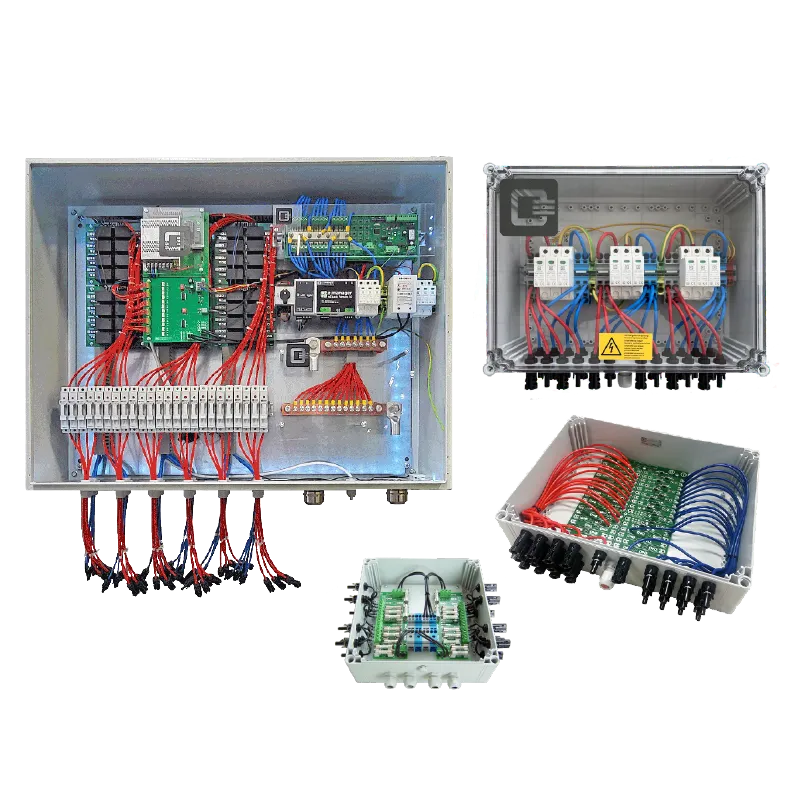
Q3 develops and manufactures DC connection technology for photovoltaic systems up to 1,500 V DC – from cost-effective standard solutions to project-specific large-scale systems. Depending on the system layout, number of strings, and protection concept, string combiner boxes, string boxes, or DC combiner systems are used.
PV String Combiner Box (SCB)
Individually configured string combiner boxes for standard-compliant parallel connection of multiple PV strings per MPP tracker.
Typical functions (depending on the version):
■ String fuses or blocking diodes for reverse current limitation
■ DC surge protection (optional, e.g., Type 1+2)
■ DC switch-disconnector / load-break switch
■ Status messages (e.g., SPD remote signaling contact)
■ Optional: Monitoring on a string basis
Area of application: Commercial, industrial, large rooftop systems, ground-mounted.
SCB LITE – Standard solution with short delivery time
SCB LITE is the cost-effective standard version for recurring system concepts in DC connection technology. Pre-configured designs reduce engineering effort and enable fast availability – ideal for installation companies and wholesalers.
Typical features:
■ Standardized design
■ Focus on cost-effectiveness
■ Optionally integrated surge protection
■ Suitable for recurring string/MPP structures
DC Combiner “Super Multi Box” for PV Power Plants
The Super Multi Box is a DC combiner system for large-scale systems with an extended protection and monitoring concept.
It is particularly suitable for systems with a high number of strings per inverter and clear segmentation in the field.
Special features:
■ Patented fault discrimination for precise identification of string faults
■ Integration of switching and isolation functions (including firefighter switches)
■ String monitoring
■ Bundling and protection of many strings
For PV power plants in the MW range and demanding O&M concepts
Customized DC solutions – “We build your PV string combiner”
If standard doesn’t fit, Q3 develops project-specific DC connection solutions – starting from quantity 1.
Typical reasons include special installation situations, high currents, special connector systems, monitoring requirements, or safety concepts (e.g., firefighter switches).
Typical adaptations:
■ Special enclosures, protection classes, cable paths
■ Individual SPD and fuse concept
■ Interfaces to monitoring/control technology
■ Quantity 1 feasible
Are you unsure which DC connection technology best fits your system?
We support you with the design – tailored to the module and inverter concept, number of strings, and protection requirements.
Distinction from AC connection technology
While AC connection technology works in the familiar low-voltage grid with sinusoidal alternating current, the DC side of a PV system places significantly higher demands on protection and switching technology. The differences are not cosmetic – they are physical.
DC and AC connection technology follow different physical laws – only the correct separation of the concepts creates a safe overall system.
Anyone who treats DC like an “extended AC distribution” risks:
■ over-dimensioning or incorrect protection
■ unnecessary material usage
■ thermal stress in the event of a fault
■ normatively vulnerable designs
Project Inquiry PV String Combiner
Would you like to design a project-specific DC connection box or a string combiner box (SCB), have protection concepts checked, or define the appropriate configuration for your photovoltaic system?
Using the following inquiry forms, we record all relevant project data in a structured and traceable manner.
You are welcome to send string plans, module data, inverter types, short-circuit currents (Isc), system voltage, or monitoring requirements directly.
⚠ Note on the Super Multi Box
For DC combiners in the MW range with an extended protection and monitoring concept (Super Multi Box), a separate inquiry form is available. Please use the specifically designated form for this purpose.

Project Inquiry PV String Combiner

Project-related design of pv string combiner, string boxes, and DC protection concepts for PV systems up to 1,500 V DC.

DC Connection Technology Download Area
Data sheets, circuit diagrams, certificates, and technical documentation for Q3 string combiner boxes (SCB) and DC combiners.
DC Combiner Super Multi Box

DC combiner for solar parks and Agri-PV with an extended protection and monitoring concept and patented fault discrimination.
Customized DC solutions
Project-specific string combiner boxes and string boxes for special requirements: special enclosures & protection ratings