


QFire AC/DC – Firefighter Safety Switch for PV Systems with Hybrid Inverters, Battery Storage and Backup Power
One shutdown. All energy sources under control. For PV systems with battery storage and backup power.
On this page
The building is disconnected from the grid – but is its power supply actually isolated? Modern battery storage systems can continue to supply the building. QFire AC/DC combines PV DC isolation with AC source disconnection.
PV Shutdown with Battery Storage and Backup Power: When Grid Disconnection Is Not Enough
Conventional PV shutdown concepts often focus on DC isolation on the PV array side. Systems with battery storage and backup capability introduce an additional supply path.
When the public grid is disconnected, a suitable hybrid inverter can switch to backup operation. The building circuits supplied from its backup output therefore remain energised.
A more comprehensive shutdown concept must address both:
- DC side: Isolation of the PV strings at defined switching points close to the PV array.
- AC side: Disconnection of the connected building circuits from both the public grid and the EPS/backup output.
QFire AC/DC – DC and AC Isolation within One Safety Concept
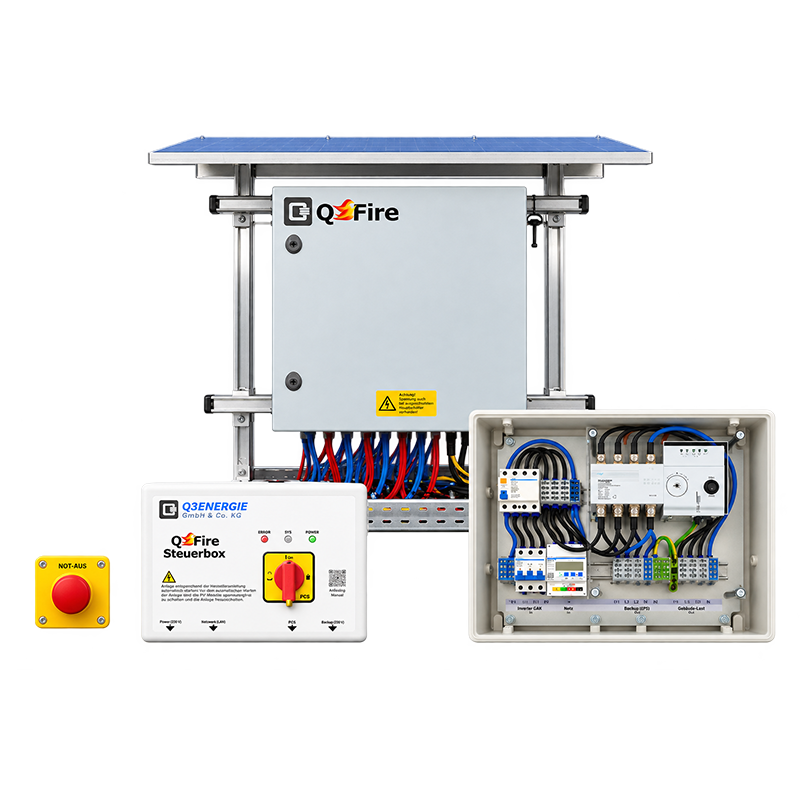
QFire AC/DC at a Glance
| Application | PV systems with battery storage and backup power |
| Switching principle | Galvanic isolation of PV strings; two-pole isolation of positive and negative conductors |
| Maximum DC system voltage | Up to 1,500 V DC |
| Maximum string short-circuit current | 20 A Isc per string |
| Number of strings | Up to 24 strings per QFire BIG switch box; larger systems use multiple boxes in a modular arrangement |
| Connections | Stäubli MC4-Evo 2; terminal connections available as an option |
| Enclosure / degree of protection | Up to 16 strings: polycarbonate, IP66/67; 18–24 strings: sheet steel, IP66; depending on configuration |
| Installation location | Sheltered outdoor area |
| Options | Type 1+2 DC surge protection, fuses, status indication and further configuration-dependent options |
| DC standards reference | IEC 60947-3; application reference: VDE-AR-E 2100-712 |
| AC disconnection | Isolation of the connected building circuits from the grid and EPS supply |
| Safety activation | Common activation via the QFire control system |
| ATS changeover | Four-pole, L1/L2/L3/N |
| ATS rated current | 63 – 630 A |
| System design | Modular, project-specific |
| Integration | External initiating device or signal |
Why PV Shutdown and Backup Power Must Be Considered Together
Distinguishing Grid Failure from Safety Activation
Automatic backup supply is desirable during a grid failure. During a deliberate safety shutdown, however, it must not continue to supply the connected building circuits.
Accounting for DC Backfeed Paths
An inverter being switched off or disconnected from the grid does not automatically mean that all connected DC circuits are de-energised. Potential backfeed from the inverter or battery storage system must be assessed against the actual system architecture.
Centralising Activation and Status Indication
A clear, centrally accessible operating and status indication arrangement supports emergency responders and those responsible for the building when initiating a deliberate safety shutdown.
Simplifying Design and Installation
Standardised interfaces and documented operating sequences help installers implement a coordinated shutdown concept and reduce the need for bespoke control logic between separate components.
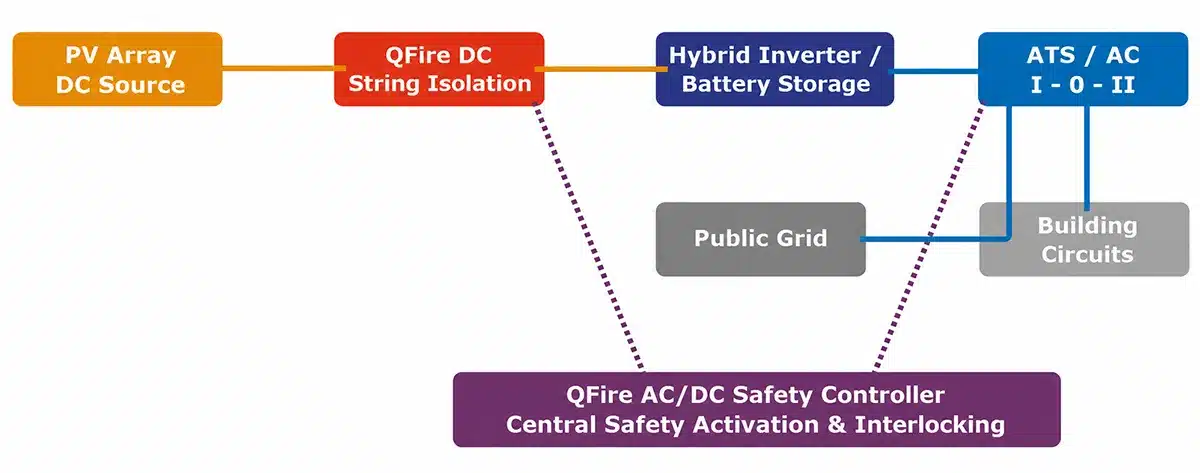
One Trigger. Two Coordinated Shutdown Functions.
The system combines project-specific QFire PV array isolation with a Q3 ATS box for grid and backup supply.
1. Central Safety Activation
Shutdown is initiated via the designated QFire safety activation interface, for example by an external firefighter/emergency-off push-button or a suitable signal from the fire detection and alarm system.
Control of the DC switch boxes and the AC disconnection function is coordinated within the common system concept.
2. Galvanic DC String Isolation
The QFire switch boxes provide two-pole galvanic isolation of the connected PV strings, disconnecting both positive and negative conductors in accordance with IEC 60947-3.
Switch box locations are selected to suit the system layout, for example close to the PV array or where the DC cables enter the building.
Isolation interrupts the supply from the PV strings to the downstream cable sections.
3. AC Disconnection from the Grid and EPS Supply
During normal operation, the Q3 ATS box automatically transfers the building’s three-phase supply between the public grid and the EPS/backup output of a suitable inverter.
Within the QFire AC/DC system, the ATS is additionally incorporated into the safety shutdown function. On shutdown, the building circuits connected through the ATS are disconnected from both AC supply paths.
This prevents automatic transfer to backup power from continuing to supply these circuits after safety shutdown has been initiated.
Safety Activation Takes Priority over Backup Supply
During a normal grid failure, automatic transfer to backup power remains available as intended. Deliberate safety activation, however, takes priority over automatic supply transfer.
The safety concept provides for an interlock to prevent automatic reconnection. The conditions for reset and re-enabling will be defined as part of system development.

Three Components. One Coordinated Shutdown Concept.

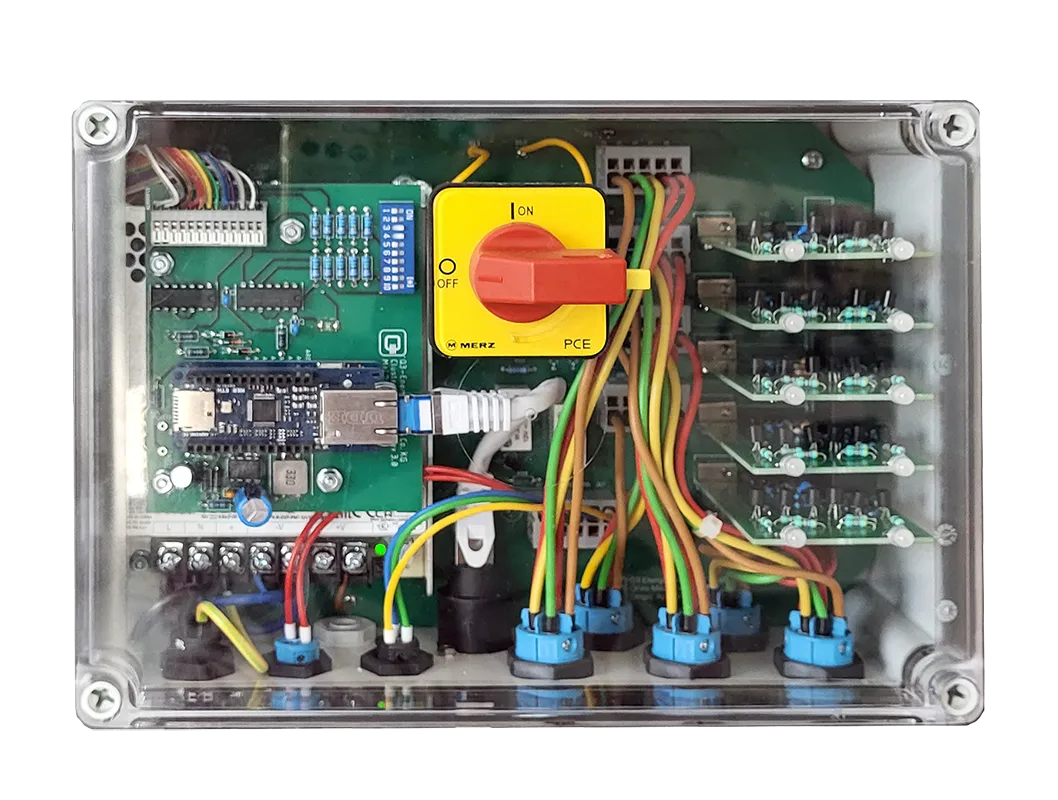
QFire Control Box – Central Safety Activation
The QFire control box provides the central interface for initiating shutdown and controlling the connected DC switch boxes. For QFire AC/DC, the AC safety disconnection function is integrated into the common control concept.
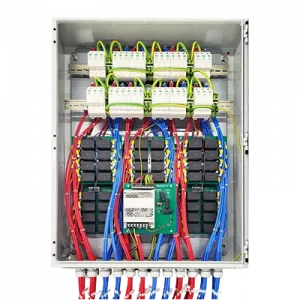
QFire Switch Box – DC Isolation on the PV Array Side
The QFire switch box provides galvanic isolation of the connected PV strings. The number of strings, DC ratings, connections and optional protective components are specified to suit the project.
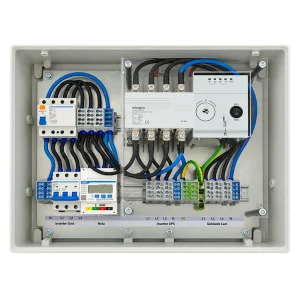
Q3 ATS Box – Grid and Backup Supply
The Q3 ATS box is a standalone grid/backup transfer assembly for three-phase building supplies up to 630 A.
A four-pole transfer switch switches the line conductors L1, L2 and L3, together with the neutral conductor N. The protective conductor PE remains continuously connected.
QFire AC/DC Shutdown Concept for PV Systems – Including Battery Storage and Backup Power
One central trigger. Coordinated isolation of defined DC and AC circuits.
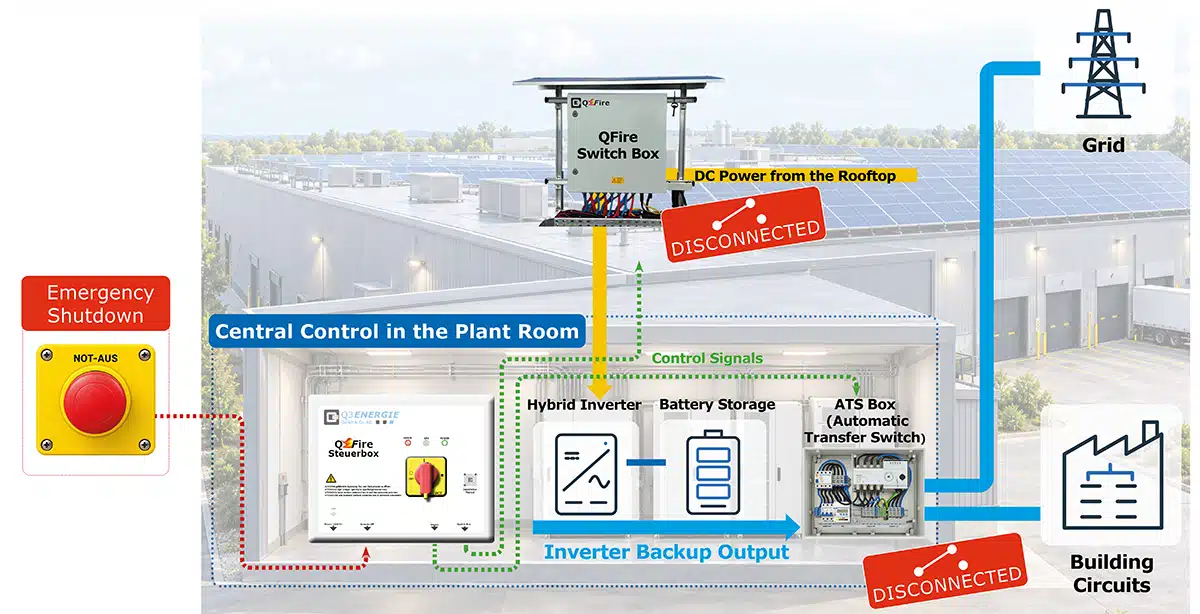
The Added Value: One Safety Concept for Multiple Energy Sources
The modular combination enables a project-specific safety architecture based on coordinated, standalone Q3 components – without having to develop an entirely new shutdown system for every installation configuration.
Essential for Hybrid Systems: Accounting for Backfeed Paths
Galvanic isolation of the PV strings interrupts the connection between the PV array and the downstream DC installation at the respective QFire switching point.
It does not necessarily mean that all DC cables throughout the system are de-energised.
Depending on the inverter and battery storage architecture, cable sections between the QFire switch box and the hybrid inverter may remain energised through internal DC connections or other backfeed paths.
System design must therefore consider all relevant energy sources and potential backfeed directions, as well as the string isolation points.
The additional ATS disconnection specifically addresses the AC supply to the connected building circuits. It does not replace any separate battery isolation or DC backfeed isolation that may be required.
QFire AC/DC for Professional System Design
QFire AC/DC is a combined system solution for PV installations in which PV array isolation, hybrid inverters, battery storage and backup power need to be incorporated into a common safety concept.
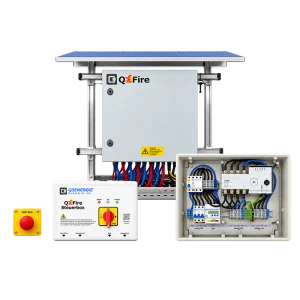
Typical applications include:
- Commercial and industrial buildings with PV and battery storage
- Installations with hybrid inverters and automatic backup supply
- Buildings with additional requirements arising from fire protection and safety strategies
- Existing installations where PV shutdown is to be extended to include AC backup supply disconnection
- New-build projects with defined isolation points and central safety activation
Key Technical Data for a Q3 ATS Box
| Feature | Specification |
|---|---|
| Rated operational voltage | 230/400 V AC, 50 Hz |
| Rated current | Project-specific, from 63 A to 630 A |
| Changeover | Four-pole, L1/L2/L3/N |
| Transfer switch | Telergon C1 |
| Utilisation category | AC-32B |
| Energy metering | Three-phase, CHINT DTSU666. Other options on request |
| Communication | RS485 / Modbus |
| Enclosure | Example configuration: 500 × 400 × 200 mm |
| Degree of protection | IP66 when correctly installed |
| Installation environment | Indoors |
The configuration described here is a standard product. Q3 ENERGIE also manufactures customer-specific and project-specific variants.
Project-Specific PV Shutdown Design with Battery Storage – Based on Proven Q3 Components
The QFire switch boxes are configured to suit the number of strings, system voltage, string currents, MPPT allocation and cable routing.
For ATS integration, the hybrid inverter, battery connection arrangement, required AC rated current and the circuits to be supplied or isolated are also taken into account.
This forms the basis of a coordinated QFire AC/DC system with clearly defined DC and AC switching points.
QFire AC/DC – Because Safety Does Not End at the Grid Connection
PV shutdown with battery storage and backup power: developed and implemented by Q3 ENERGIE – with project-specific design, coordinated components and direct access to our technical team.
Project Inquiry Firefighter Switch
Project-specific inquiry for QFire system design. Component selection and quotation preparation.

Technical Documentation Firefighter Switch

Data sheets, certificates, and technical documentation for QFire BIG and LITE, control boxes, switch boxes, and accessories.
QFire Operating Principle
and Technical Details
Technical fundamentals of DC-side disconnection, system design, triggering methods, galvanic isolation, and standards-compliant implementation.

FAQ on Firefighter Switches

Answers to frequently asked questions about applications, standards, activation concepts, installation requirements and operation.